Search
Regions
18th Century
18th Century Naturalists in Newfoundland and Labrador
The following is a summary of the papers which discuss the contributors to our knowledge of the 18th Century ornithology of Newfoundland and Labrador. Each paper, arranged in chronological order, can be read by returning to the main menu and clicking on it.
Bill Montevecchi in his excellent history Newfoundland Birds, Exploitation, Study, Conservation is the author of the best example of a Canadian provincial ornithological history. Including everything relevant, he includes the results of an examination of bird bones found in aboriginal middens at Cow Head on the west coast of the Newfoundland north of Corner Brook. The archaeological record reveals over twenty species of birds. These include early first records of the presence in Newfoundland of birds such as Harlequin Duck, Northern Gannet, Common Loon and Atlantic Puffin. Dr Montevecchi also chronicles other early records of aboriginal peoples and notes passing references to birds in the accounts of the first European visitors to the island.
Where archaeological research of aboriginal middens reveals important Canadian provincial records I have written accounts in some detail. In the case of the Cow Head middens, since all the species identified are well-known to inhabit the province today no further details are provided.
Readers interested in a more thorough account of the early ornithological history of Newfoundland and Labrador are encouraged to read Newfoundland Birds. This introduction provides a brief more nuanced summary of the pre-19th century period followed by in-depth papers on the key contributors to the early history of Newfoundland and Labrador ornithology.
The first European contact with Newfoundland and Labrador came with the Viking explorations which resulted in a brief settlement at L’Anse-aux-Meadows on the northern tip of the island of Newfoundland. The likely date of settlement was 1031.
European explorations are known to have been resumed with the exploration of John Cabot in 1497. Cabot’s discovery of the Grand Banks fishery lead to widespread European interest in exploration of the northwest Atlantic in the 16th century. In 1500 and 1501 the Portuguese explorer Gaspar Corte-Real is known to have explored part of the Labrador coast, visiting Hamilton Inlet and the Strait of Belle Isle. He brought back a group of Innu to Portugal. In the 16th century Labrador was known as Terra Corterealis. Jacques Cartier entered Newfoundland waters landing at present day Catalina on the Bonavista Peninsula on May 10, 1534. After a brief stay he visited the great seabird colony on the Funk Islands, which lie 75 kms east of Fogo Island. At the Funks his crew collected quantities of Great Auks. Cartier proceeded through the Strait of Belle Isle and subsequently explored the St. Lawrence River.
Before Cartier the French, Portuguese and the Basques established seasonal fishing operations along the east and south coast of Newfoundland in close proximity to the fishing banks. The Basques also set up whaling stations along the Labrador side of the Strait of Belle Isle as early as 1530. (Rompkey The Story of Labrador p. 19). Red Bay and Chatteau Bay were prime sites. The impetus for Basque operations in Labrador may have been the result of Corte-Real’s explorations. In 1583 Sir Humphrey Gilbert claimed Newfoundland for Britain. Rompkey notes that numerous British explorers sailed up the Labrador coast in the 16th and 17tth centuries in search of the Northwest Passage.
In the early 17th century Britain founded colonies on the Avalon Peninsula at Cupids, Ferryland and Trepassey. The French founded New France with the establishment of a settlement at Quebec in 1608. They also founded Acadia in what is now Nova Scotia, New Brunswick and Price Edward Island They set up headquarters for their Newfoundland interests at Placentia on the west side of on the Avalon Peninsula in 1662.
Europeans writing about Newfoundland birds often applied local common names to the land and seabirds they encountered. Montevecchi sorts through the identification of these bird names and vague descriptions from various writers such as Richard Howe (1536), Sir Humphrey Gilbert (1583) and Pierre Detchevery Dorre (1677). Names were mostly given to birds sought out for food especially seabirds and their eggs. Birds provided an important source food which supplemented the diets of early fishermen, sailors and residents.
Flightless Great Auks were known as “penguins” by the French and English and “dukes” by the Basques. Long known to nest on the Funk Islands they were especially sought out as an easy source of food. Some of the waterfowl and seabirds encountered in Newfoundland waters also ranged to northern Europe and were known to the European fishermen and sailors.
Perhaps the most useful writing on birds in the 17th century are the accounts of a few seabirds provided by Nicolas Denys and Marin de Dierville. Please see Early French Observers on the Grand Banks in this section under 17th century .
St. John’s was occupied seasonally from early in the 16th century. Despite its early beginnings it was one of numerous population centres on the island based on the salt cod fishery. In the late 1700s the population of St. John’s was estimated at 4,000. As noted in the online article “The Rise of St. John’s”.
the most wealthy merchants in Newfoundland between 1775 and 1793 did not trade from St. John's but from Trinity. Such places as Harbour Grace, Carbonear, Ferryland, Placentia and Little Bay could boast merchants who were as large and important as any in St. John's... Impacts of the American Revolution encouraged the West Indies trade which favoured St. John’s. The transfer of many business houses from England to St. John's during the Napoleonic Wars and the rise of the Labrador fishery and the sealing industry which required financing which further benefited St. John’s as a centre of trade. These factors enhanced by the increased demand for salt fish during the Napoleonic Wars (1791-1815) encouraged the growth of the colony of Newfoundland and St. John's by the end of the 18th century.
The map of Newfoundland and Labrador immediately below places the province on the eastern edge of Canada. Population centres mentioned in the text show the location of the French Islands of St. Pierre and Miquelon off the south coast of the island of Newfoundland, Trepassey, Pacentia and St. John’s in the extreme south-east of the island, the Bonavista Peninsula and the Funk Islands where Jacques Cartier landed and Cartwright and Nain, along the Labrador coast. The Grand Banks fishery lies approximately 200 miles off the extreme southeast coast of the island.
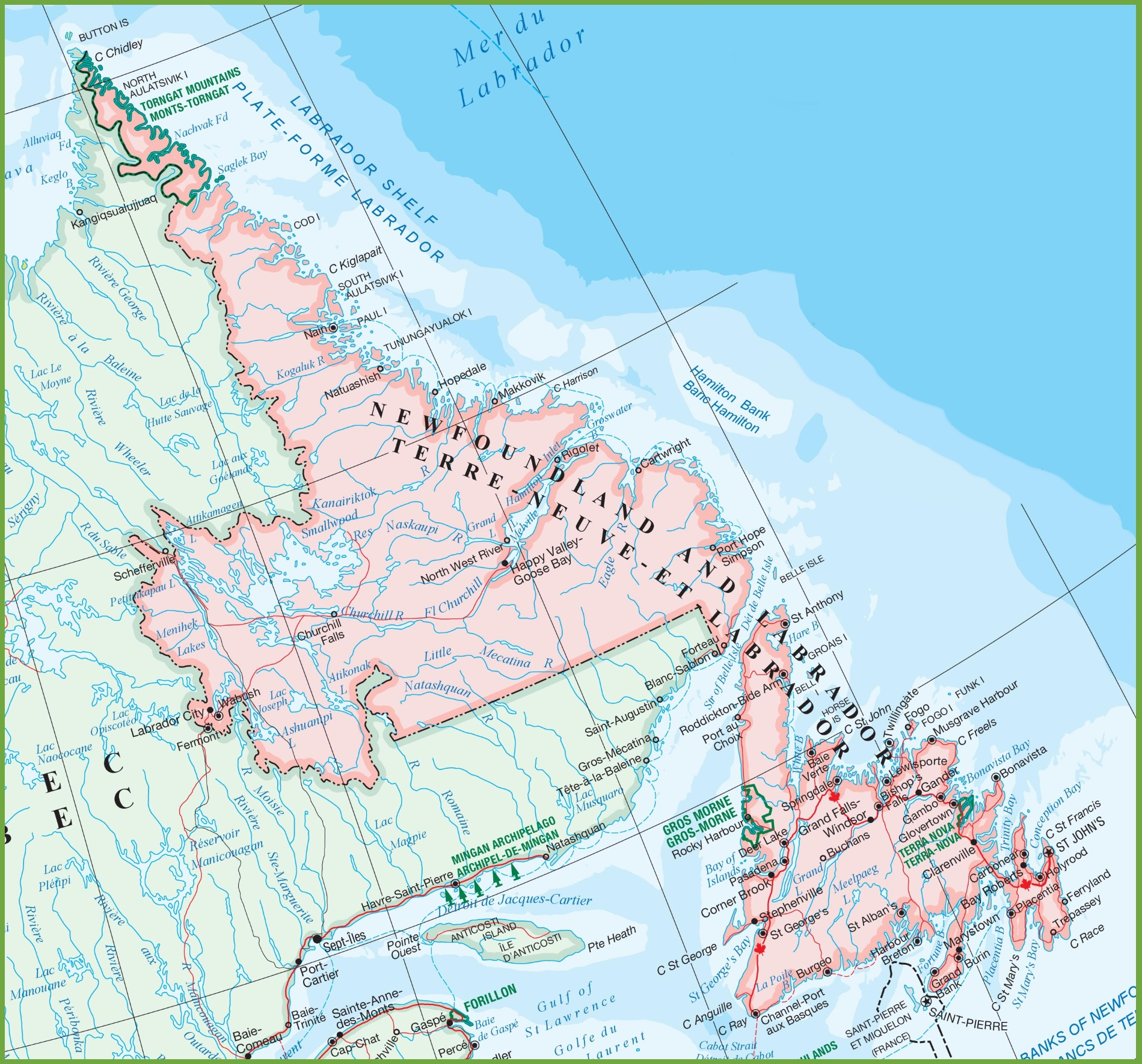 Reference: https://www.canadamaps.com/detailed-map-of-newfoundland-and-labrador/
Ornithology of Newfoundland and Labrador
Ornithological knowledge of Newfoundland and Labrador commenced with the development of European interest in the collection of natural history specimens for newly established museums and private collections. The advancement of science of ornithology in the middle of the 18th century demanded new material to assist in the understanding of bird classification. Advances in taxidermy allowed for their collection, preservation and study.
Perhaps it is not surprising that the first known specimens collected in Newfoundland came from fishing captains who found a reason to preserve the seabirds caught as by-catch in their nets. Our knowledge of these early records can be found in the some of the first ornithological books: A Natural History of Birds by Eleazear Albin published in 3 volumes between 1731-1738 and George Edwards in two multiple volume sets: A Natural History of Uncommon Birds in 4 volumes (1743-1751) and Gleanings in Natural History in 3 volumes (1758-1764).
Albin’s book featured the Common Loon, the first coloured engraving of a Canadian bird. Edwards books included five seabirds caught in Newfoundland waters. Papers on Albin and Edwards and their contribution to Newfoundland and Labrador ornithology can be found in this section.
Britain took control of most of Newfoundland and all of Labrador with the signing of the Treaty of Paris in 1763 at the end of the Seven years War. This event led to the botanical and zoological collecting expedition of Joseph Banks to Labrador and Newfoundland in 1766. Unfortunately Banks never published the results of his extensive collecting activity. Much of what we know about Banks’ expedition is found in the publications of ornithological historians Averil Lysaght and William Montevecchi. Both examined Banks’s unpublished journals and notes, the paintings commissioned by Banks and Taylor White, and the writings of Thomas Pennant. The results of Banks’s expedition discussed in a major paper in this section provides the first and most significant ornithological record of birds in the province prior to the 19th century.
The Moravians were a European Protestant sect interested in bringing religion to aboriginal peoples. They organized a series of explorations to Labrador which resulted in the founding of Nain in 1771. Of greatest interest to ornithologists was their 1765 multi-disciplinary expedition which examined coastal waters between Chateau Bay in southeast Labrador and Davis Inlet north of Hopedale. The two and a half year exploration included naturalist Andreas Schloezer who wrote a manuscript which noted birds and mammals observed and collected. The paper on the Moravians provides details of their ornithological legacy in the province.
Entrepreneur and naturalist George Cartwright spent 16 years establishing and operating his trading business in south central Labrador. Cartwright wrote A Journal of Transactions and Events, during a Residence of Nearly Seven Years on the Coast of Labrador Containing Many Interesting Particulars, Both of the Country and Its Inhabitants published in 1792. A long-lost Cartwright manuscript, edited by Marianne Stoop, entitled George Cartwright’s The Labrador Companion has more recently been found and published in 2016. These two books, which contain Cartwright’s natural history observations, establish him as one of the most important 18th century Canadian naturalists. Readers will find an extensive paper on Cartwright in this section.
Included in these papers is a very short account by Elizabeth Simcoe. She wrote about the birds she encountered during a passage along the southern shore of Newfoundland in the fall of 1791. Elizabeth was a talented artist with a strong interest in natural history and birds. She was accompanying his husband, John Graves Simcoe, who was on his way to take up the post of Lieutenant Governor of the new province of Upper Canada.
Finally a few observations on the bird life of Newfoundland and Labrador are included in a book by Aaron Thomas discussed in another short paper. Thomas visited Newfoundland in a British patrol boat in 1794. His book entitled The Newfoundland Journal of Aaron Thomas, published in 1968, features some interesting observations from around Newfoundland. Most important is a graphic first-hand account of the slaughter of Great Auks on Funk Island.