Search
Regions
The Moravians
(1765)
Labrador was first occupied by Europeans in the 16th century when the Basques established whaling stations in southeast Labrador along the Strait of Belle Isle. In the 17th century Basque and Portuguese fisherman were operating seasonally from the area. In the early 18th century fishermen and traders from New France extended their operations east along the Quebec north shore into southern Labrador. In 1735 Louis Brazil had established a fur trading post at Chateau Bay in southeast Labrador. By 1743 French influence had extended as far as North West River where Louis Fornel established a fur trading post at Lake Melville.
Labrador passed into the hands of the British in 1763 under the terms of the Treaty of Paris that ended the Seven Years War. As a result the British built York Fort at Chateau Bay and established fishing stations and fur-trading enterprises in the former French territories. The most important trader in this period was British merchant and naturalist, George Cartwright, who set up operations in southeast Labrador.
The most important naturalist to visit Newfoundland and Labrador in the 18th century was Joseph Banks. In 1766 he spent the late summer and early fall at Chateau Bay and in northern Newfoundland where he conducted plants and zoological specimens.
The Moravians, a European Protestant sect, were interested in bringing their form of Christianity to the Inuit of Labrador. Their first venture, in 1752, led by Johannn Christian Erhardt, was a failure. After the conquest in 1759, they sought the co-operation of the British government. Banks, well connected to the British aristocracy, took advantage of this new relationship to secure the co-operation of the Moravians to collect natural history specimens during their initial explorations.
The early history of ornithology by Moravians in Labrador commenced with the expedition by the scientifically trained naturalist, Christain Andreas Schloezer (1738-1769). He was accompanied by Jens Haven (1724-1796), Laren Drachardt (1711-1778) and John Hill. Their exploration from Chateau Bay north to Davis Inlet area was conducted in the summer of 1765. As noted by Cayouette in an article “Contribution des Moraves a La Bryologie du Labrador” in Carnets de bryologie, Schloezer collected vascular plants for Banks. Schloezer’s botanical specimens are found today in the Banks Herbarium at the British Museum and in other European herbariums.
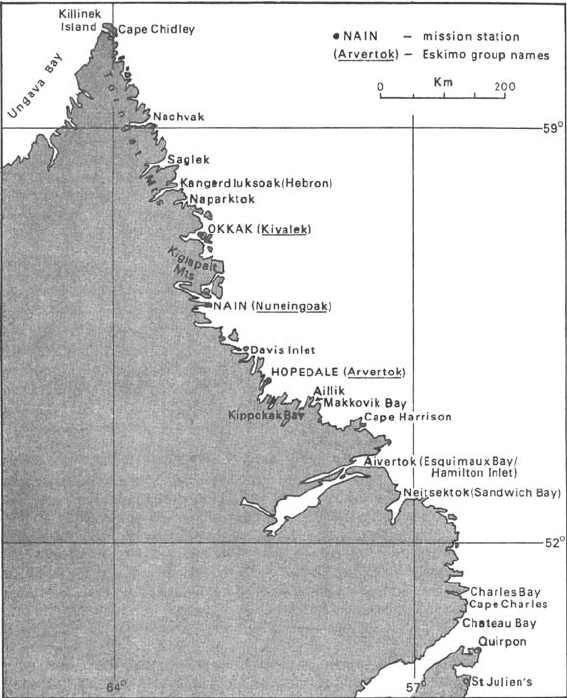
Expeditions by Haven and Drachardt in 1764 and 1770 paved the way for Christoph Brasen (1738-1774) to establish a permanent settlement of Nain in northern Labrador in 1771. Additional settlements were established to the north at Okak in 1776 and on the central coast at Hopedale in 1782.
The Haven and Schloezer Expedition of 1765
Eminent historian, Averil Lysaght, had a strong interest in natural history and ornithology. Her most important Canadian work included in-depth research into Joseph Banks’s exploration of Newfoundland and Labrador entitled Joseph Banks in Newfoundland and Labrador, 1766. Banks spent considerable time collecting botanical and zoological specimens at Chateau Bay, Labrador. Lysaght’s book includes three chapters on the Moravians in Labrador.
Lysaght provides some background on Schloezer’s 1765 voyage which was undertaken in the British schooner Hope. Lysaght noted:
the natural history observations in these versions [various expedition diaries] are not at all detailed, one man was a sufficiently good botanist to collect plants for Banks; there is an interesting record of wigeon in Davis's Inlet on 8 August. (Lysaght:182).
Lysaght appears to have accepted the accuracy of this record. The journal passage (apparently written by Schloezer) reads:
Noted plenty of large timber. Haven and fellow passengers also saw many geese, ducks and wigeon.
This is the most detailed account of wildlife on the 1765 expedition recorded in numerous diaries that have been found. Since wigeon are not found on the northern Labrador coast the wigeon record is most likely in error.
A few more bird observations were found in the journal of the expedition entitled Journal of Jens Haven and A. Schloezer to explore the coast of Labrador in the Hope from 23 July to 3 September 1765”. A copy has been examined at the Centre for Newfoundland Studies’ Microfilm 512 Reel #1 which provides a little more detail than the Lysaght note, as follows:
August 7: The party went 12 miles into Davis Inlet and then walked for several miles; they  recorded “seals, ducks, partridge & small fowl we saw plenty...

August 8; the *Hope* continued to a distance of 16 miles from the entrance at which point the   water too shallow to proceed; they noted “many geese, ducks & wigeons
While I found little additional useful information, the following Journal details about the expedition, and places where Haven and Schloezer visited, are presented here:
- John Hill, Jens Haven, Chr. Drachard abd S. Schloezer all kept journals of their 1765 voyage; extracts were presented to the London Board of Trade;
- the exploratory voyage embarked from Spithead on May 7; arrived at Pitts Harbour, Chateau Bay Labrador on July 17 where they remained for about one week; their main interest there seemed to be learning about the trading interests of the aboriginal peoples;
- they set out from Pitt’s harbour on July 25; the Journal account of Haven and Schloezer in Hope contains a few natural history observations (previously noted) on the trip north towards Davis Inlet (55.51N Wikipedia) where they arrived on August 5; they ventured as far as “Cape Endeavour” on August 25 noted as 55 degrees, 45 north (south of Nain which is at 56.32”N);
- they returned to Pitts Harbour on September 8th;
- in mid-September they visited Funk Island;
- embarked from Pitts Harbour on September 14, arriving St. John’s on October 4, embarked in early November and landed at Plymouth in late November.
Readers will note that the Latitudes were compiled from the Hope’s Ship’s Log (Lysaght:225). One can conclude that the exploration of the coast did not get as far as Nain. The elapsed time in Labrador was about 2 1/2 months.
As noted by Professor Hans Rollmann of Memorial University of Newfoundland in the Newfoundland Quarterly:104:34 (2012), Schloezer was “commissioned to record the flora and fauna and other natural phenomena of Newfoundland and Labrador”. Rollmann writes: “Two scientific manuscripts were the result of these earliest observations in 1765.” Given the presence of plant material in the Banks Herbarium, it seems likely that Schloezer may well have collected ornithological material as well. These manuscripts noted by Dr. Rollmann were not found with the aid of an archivist at the Centre for Newfoundland Studies at Memorial University in St. John’s.
Schloezer, a naturalist, was the author of the manuscripts. He was born in Buchsweiller, Germany. He was directed to collect plants, animals and minerals in Newfoundland and Labrador by Johann Jakob Bossart, Director of the natural history collection at the Moravian Seminary at Barby, Saxony. In his list of the flora and fauna collected, Schloezer used as reference the natural history material in Cranz’s Histoire von Gronland.
Schloezer’s two scientific manuscripts were mentioned by Thea Olsthoorn in her Chapter “Cranz’s Greenland as a Stepping Stone to Labrador: Tracing the Profile of the Inuit” (Footnote 27 p. 243-244). The chapter appears in the Jensz and Petterson edited Legacies of David Cranz’s Histoire Von Gronland (1765). While the relevant pages in the chapter are not available on-line, the footnote mentions that the manuscripts are held in the Moravian Archives in Herrnhut, Germany. The titles and references are as follows:
The Botanical and Mineral Manuscript
Observa ex Regno minerali & vegetabili in Terra Labrador & propter propinquitateem in Insula Nova Terra. Ref: UA, NB VII R.2. 40;
The Mammal and Ornithological Manuscript
Regnum animale Ref: UA, R. 28.39
Hopefully additional research will provide access to the ornithological material.
Lysaght’s book was published in 1971. She was unaware of these scientific manuscripts. Todd, in his exhaustive research in his pioneering Labrador ornithological work Birds of the Labrador Peninsula, published in 1961, was also unaware of their existence. In his brief introduction to the ornithological history of the Labrador Peninsula he states while discussing the 1833 visit of Audubon to Labrador (Quebec north shore) in the early 19th century:
It was somewhat later in the century, so we learn from scattered references, that specimens of Labrador birds began to trickle in to various museums in German – transmitted by interested members of the Moravian mission staff.
Montevecchi in his Newfoundland Birds provides an extensive detailed account of ornithological observations in Newfoundland and Labrador from pre-historical times to the present day. Like Todd and Lysaght he makes no mention of Moravian ornithological research in the 18th century.
Jens Haven’s Observations at Hopedale 1769
In Newfoundland Studies Volume 28, numéro 2, fall 2013, p. 153–192 “Hopedale: Inuit Gateway to the South and Moravian Settlement” Hans Rollmann presents information on Jens Haven’s account of Arvatok, now Hopedale. He provides some brief undated notes on the bird life (p. 178) under the following headings as follows:
Sea birds
of all kinds are here, very numerous in summer and thus there are also many eggs in spring. There are also many wild geese [Canada Geese] here, which hatch their young here.

Land birds
There are also ptarmigans [Willow Ptarmigan], (footnote 133) but fewer than in Nain and Okak. There is here, however, in fall a kind of “Schnepper” (footnote 134) that are approximately as large as a dove, and it is the fattest and best-tasting bird that I have seen.

Footnote 133: Rupper is also listed in Moravian records as Rypen or Ripper and “is likely a ptarmigan or grouse.

Footnote 134: Schnepper or Schnäpper can represent a variety of robin.
Christoph Brasen at Nain 1771
Christoph Brasen was a trained surgeon who initially served the Moravian mission in Greenland in 1769. During his brief visit he studied the natural history of Greenland. Hans Rollmann in a short biography of Brasen in the on-line “Lives and Narratives of the Labrador Missionaries” (URL not noted) mentions that he published Some Natural Observations of Brother Brasen about the Weather, the Plants and Herbs, the Minerals and some Accompanying Birds. (R.15.J.a No. 14 Moravian Archive)
Brasen initiated the historic weather observations at Nain from 1771. Until his untimely accidental death in 1774, he was the leading scientist at the mission. Meteorological observations continued on and off for over 200 years providing a treasure trove of scientific data. Lysaght notes (p. 183) that Brasen’s natural history interests were mostly botanical. It appears that his ornithological observations were sporadic, considerably less rigorous, and add no value to the study of the ornithology of Labrador.
The limited habitat diversity and extreme climatic conditions in central and southeastern Labrador create an extremely limited avifauna. Given the important 18th century records of the Banks Expedition to southern Labrador in 1766, and the unique ornithological contribution of George Cartwright, who spent many years in the same area, it seems doubtful that Schloezer's Moravian expedition of 1765 will make a significant ornithological contribution to what is already known. A preliminary analysis of the Moravian ornithological contributions of Jens Haven at Hopedale and Christoph Brasen at Nain appear to add little to the 18th century historical record.
One final notes on Moravian bird records. Thomas Pennant used many sources for his Arctic Zoology. This included a record of a Razorbill from Labrador provided to him by Peter Simon Pallas which he obtained from the Moravian missionaries. It is possible that the Pallas archive may have additional Moravian records.
In conclusion, contemporary bird records from the east coast of Labrador affirms that the area does not support a rich avifauna. In the summer of 2011, Parks Canada biologist, Darrock Whittaker, in a five week study of wildlife, primarily birds, in the Torngat Mountains National Park, north of Nain, recorded 37 species. eBird records in settlements from Nain south along the Labrador coast are scarce. Species numbers available from the settlements as of 2024 unless otherwise stated are as follows:
- Nain: 55
- Hopedale: 31 (2023)
- Makkovik: 24 (2023)
- Cartwright: 69
- Mary’s Harbour: 69
The extensive Labrador records provided by the Banks expedition of 1766 (45 species) supplemented by 46 species published by George Cartwright, including 13 not recorded by Banks, brings the known 18th century Labrador total to 59 species. In the circumstances it is likely that an examination of the Moravian Mammal and Ornithological Manuscript, while an important historical document, will add few new records to our knowledge of 18th Century Labrador ornithology.
Bibliography
- Brasen, C. 1769. Some Natural Observations of Brother Brasen about the Weather, the Plants and Herbs, the Minerals and some Accompanying Birds. Unpublished Manuscript. R.15.J.a No. 14 Moravian Archive. Herrnhut, Germany
- Cayouette, Jacques. 2013. “Contribution des Moraves a La Bryologie du Labrador” Carnets de bryologie 3:1-12 Online publication https://docplayer.fr/63309013-Contribution-des-moraves-a-la-bryologie-du-labrador.html
- Haven, Jens and A. Schloezer. 1765 Journal of Jens Haven and A. Schloezer to explore the coast of Labrador in the Hope from 23 July to 3 September 1765. Centre for Newfoundland Studies. Microfilm 512. Reel No. 1
- Hillier, J.. K. 2009. The Moravians in Labrador 1771-1805. Cambridge: Cambridge University Press
- Lysaght, Averil. 1971. Joseph Banks in Newfoundland and Labrador, 1766. Berkeley and Los Angles: University of California Press
- Montevecchi, William and L. M. Tuck. 1987. Newfoundland Birds: Exploration, Study, Conservation. Cambridge MA: Nuttall Ornithological Club
- Olsthoorn, Thea. “Cranz’s Greenland as a Stepping Stone to Labrador: Tracing the Profile of the Inuit” in Jensz and Petterson edit. Legacies of David Cranz’s Histoire Von Gronland (1765).
- Rollmann, Hans. 2012. ““Hopedale: Inuit Gateway to the South and Moravian Settlement” in Newfoundland Studies Volume 28, numéro 2, fall 2013, p. 153–192
- Rollmann, Hans. 2012. “Moravians & Labrador Fauna. An Interview with Dr. Hans Rollmann” Newfoundland Quarterly:104:34. St John’s: Memorial University of Newfoundland
- Todd, W. E. Clyde. 1963. Birds of the Labrador Peninsula. Toronto: University of Toronto Press and Carnegie Museum
- Whitaker, Darrock. 2011. Birds Recorded in northern Labrador 211. Online listserv nf.birds