Search
Regions
John James Audubon
(1785-1851)
John James Audubon is arguably the best known 19th-century bird artist, and his works are still highly valued today, though more recently Audubon's life and views come under criticism by historians and naturalists. Nevertheless, as the National Audubon Society says, "His contributions to ornithology, art, and culture are enormous …”. He traveled extensively over eastern North America to collect birds for his famous Birds of America, published in parts between 1828 and 1838. He was a keen observer of wildlife, and his field notes were compiled for the companion five-volume Ornithological Biography, published between 1831 and 1839.
Audubon's contributions to Canadian ornithology are related to his numerous visits to Atlantic Canada. The most important was his visit between June and August 1833, when he took his well-known trip to Labrador. Audubon’s letters indicate that he planned an expedition by boat which included visits to Nova Scotia, the Magdalen Islands, the Quebec north shore, and even further north to Hudson's Bay, with an overland return through northern Quebec. (Corning: Letters 1:197 Audubon to John Bachman February 19, 1833). By the time Audubon was finalizing his plans, he omitted Hudson's Bay but still planned to visit Quebec. In a letter to his son, Victor on May 31, 1833 he outlines his revised itinerary:
We hope to be busy on the Labrador coast by the 15th of June and continue to be so until the first of September, when dark Winter already making her approach will send us back to Eastport [Maine]; from which our Party ... will proceed to Quebec ...
In undertaking this expedition, Audubon noted a number of objectives:
One motive for my journey to Labrador was to ascertain the summer plumage and mode of breeding of the Water Birds which in spring retire thither for the purpose of rearing their young in security, far remote from the haunts of man. (*Biography* 2, Introduction, xxv)
Audubon expected that this trip presented a huge opportunity to collect and study many new birds for his works. In going to Labrador he was no doubt influenced by the reports from the local Maine fishermen who knew it from their regular summer fishing trips there. This is confirmed in a letter from Labrador sent by one of his companions George Shattuck to his father (Townsend, In Audubon’s Labrador):
BRADORE, Latitude 51, Monday, August 5, 1833.

we have not found Labrador, the country that the fishermen would have us believe. I expected to have obtained many curious specimens in comparative anatomy, but we have seen no quadruped larger than a rat ... Birds are much less plenty than we had been taught to expect them. Mr. Audubon has obtained much valuable information, and we all are glad that we have seen this country, for no description can convey a just idea of it. Labrador was not made for white men, and it is to be wished that it had been left in the possession of those whom God placed there. We have traveled over the country very thoroughly, and can bid adieu to Labrador without regret ...
As is shown in Audubon's published writings about bird species he encountered, he was often willing to accept other people's erroneous views about birds in general, and in particular. This was not a problem for his Nova Scotian bird records as they were supplied to him by the naturalist Thomas McCulloch Jr. It was a major problem on the Quebec north shore where Audubon willingly accepted dubious records from local people who had only the vaguest knowledge of local birdlife.
Audubon set out from Eastport in the Ripley on June 6, 1833 and arrived at the Magdalen Islands on June 12th. After a few days collecting he visited the famous Bird Rocks in the Gulf on June 14-15. He completed his crossing of the St Lawrence, arriving at Natashquan on the Quebec north shore, on June 17th.
Not long after his arrival he encountered the survey ship Gulnaire, captained by Henry Bayfield who was carrying out coastal surveys along the Quebec north shore. He noted that Gulnaire crew member, Lieutenant Augustus Bowen, gave him the skin of a Peregrine Falcon. (Audubon and His Journals I: 391).
Over the next two months Audubon's party explored four major sites along the Quebec north shore, sailing east as far as Bradore, near Blanc Sablon. Despite Audubon's constant reference to Labrador, his whole expedition was spent in what is now Quebec. They left Bradore on August 11, arriving in Newfoundland on the evening of August 12. In total 115 species of birds from Atlantic Canada can be confidently attributed to Audubon.
Audubon’s Quebec Bird Records
Audubon recorded 26 species from the Magdalen Islands and Bird Rocks, and 75 from the Quebec north shore. Three species from the Magdalens - Piping Plover, Barn Swallow and Hermit Thrush - were not recorded on the Quebec north shore, giving a Quebec expedition total of 78 species. I have excluded many more potential records. This tally is the result of my detailed analysis of all the records available, with a heavy reliance on the meticulous research of American ornithologist, Clive Todd. Todd examined Audubon’s records in detail for the publication in 1963 of his impressive The Birds of the Labrador Peninsula.
The following is a summary of Audubon’s Quebec records:
| Magdalen Islands & Bird Rocks | QC North Shore | |
|---|---|---|
| Specimens Collected | 1 | 33 |
| Nesting Confirmed | 6 | 15 |
| Site Record Only | 19 | 27 |
| Totals | 26 | 75 |
It is highly likely that any birds found nesting by Audubon were collected, and this would potentially bring the number of bird species collected to 55. From the Magdalen Islands this would include the nesting record of Piping Plover but not the site records for Barn Swallow and Hermit Thrush.
Todd was not impressed by Audubon. He noted: “Insofar as Labrador is concerned too much respect has been paid to Audubon as an authority. After every allowance has been made, his work was carelessly done and poorly recorded.” Todd made the following comments on Audubon’s unscientific approach to record keeping:
there are many disquieting discrepancies and anomalies [and he] must have relied on his memory rather than on his records in writing his biographies...he seems to have had only the vaguest ideas about bird distribution, despite his extensive travels. To him there was nothing incongruous about finding in Labrador some species already known to him in the south.

He has been quoted as authority for a goodly number of such records for which there is no other support, and which in my judgment are unworthy of credence. Nor can his identifications always be trusted. He was especially confused over the Gulls, Terns, Flycatchers, and Thrushes. In the Appendix...we find casual and off-hand citations of Labrador in his list of localities for certain species. It is significant that these species are not mentioned in his Labrador Journal, and most of them have not been found in the country by anyone else since.  (Birds p. 731-32)
Despite the difficulties with geography, problems with identification and record keeping, gleaning verifiable species from Audubon’s species accounts, bird descriptions and paintings is of great significance, given the paucity of other Quebec and Atlantic Canada bird records available for this time. The reality is that most of the 78 species listed for Quebec represent first records, either because they were collected and described, or are genuine sight records, which reveal for the first time the presence of the species in the province. Some of the highlights are discussed below.
Without question, Audubon would rank as the most important field ornithologist to visit Quebec since the founding of the colony of New France in 1608. He was the first to visit the Magdalen Islands, the Gulf Bird Rocks and the Quebec north shore. Prior to 1840, Audubon’s record of 78 Quebec species is second in importance only to the work of Archibald Hall, who inventoried almost 200 species in the collection of the Montreal Natural History Museum in 1839. Hall was, however, what one might describe as a “cabinet ornithologist”.
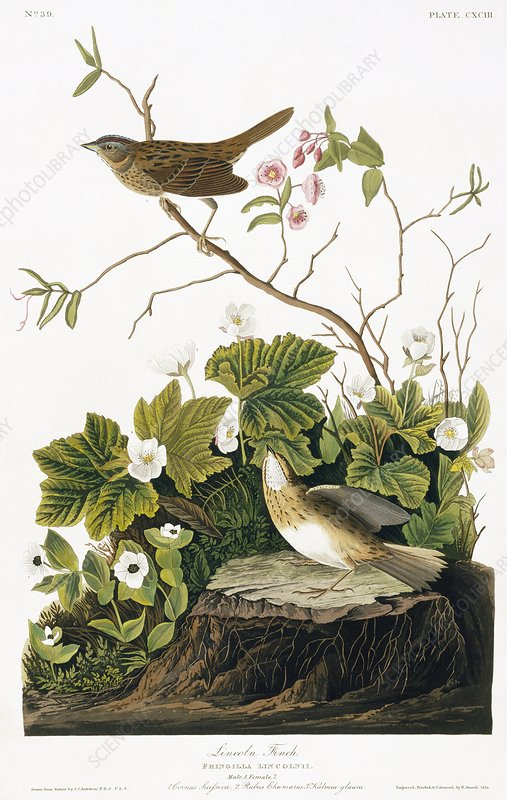
On the 1833 trip Audubon collected one bird new to science, the Lincoln's Sparrow, named after one of his assistants, Thomas Lincoln. Audubon describes the event on June 27th in his Journal:
We shot a new species of Finch, which I named Fringilla lincolnii; it is allied to the Swamp Sparrow in general appearance, but it is considerably smaller, and may be known at once from all others thus far described, by the light buff streak which runs from the base of the lower mandible, until it melts into the duller buff of the breast, and by the bright ash streak over the eye. The note of this bird attracted me at once; it is loud and sonorous; the bird flew low and forward, perching on the firs, very shy, and cunningly eluding our pursuit; we, however, shot three, but lost one. I shall draw it tomorrow. (Audubon and His Journals 1: 382)
By far the most important site visited was the Quebec north shore where Audubon did the bulk of his Canadian collecting. In total he collected almost 200 bird specimens on his Atlantic Canada expedition. It is not surprising that seabirds and boreal species formed the majority of his collection. These specimens formed an important source of new plates for his Birds and his field notes and descriptions from the specimens were of great value in completing the accompanying Biography.
The ornithological results from this Quebec trip are examined below.
Bird drawings made by Audubon in Quebec
Since the only place where Audubon was not constantly on the move was the Quebec north shore, the majority of the birds that Audubon collected and drew during the expedition were procured during his two-month visit between June 17 and August 11, 1833. By August 5 he had made, or was working on, 21 drawings of birds. (JJA to Mrs. Audubon from Bras d’Or, Coast of Labrador, August 5, 1833, Corning, Letters of John James Audubon 1826-1840 1: 239)
In a letter Audubon sent to his son Victor from New York, sent on September 9, 1833, he states he had mostly completed 25 drawings and provides details as to the species and their composition (Letters I: 243):
I made 25 drawings; all of which are not finished but I have more than enough to complete 2d Vol., to my Entire satisfaction the 2 large plates are one a covey of the Willow Grouse [Willow Ptarmigan], Male female & young, very beautiful, the other the Labrador Falcon [Gyrfalcon], Male and Female, John killed both of these.
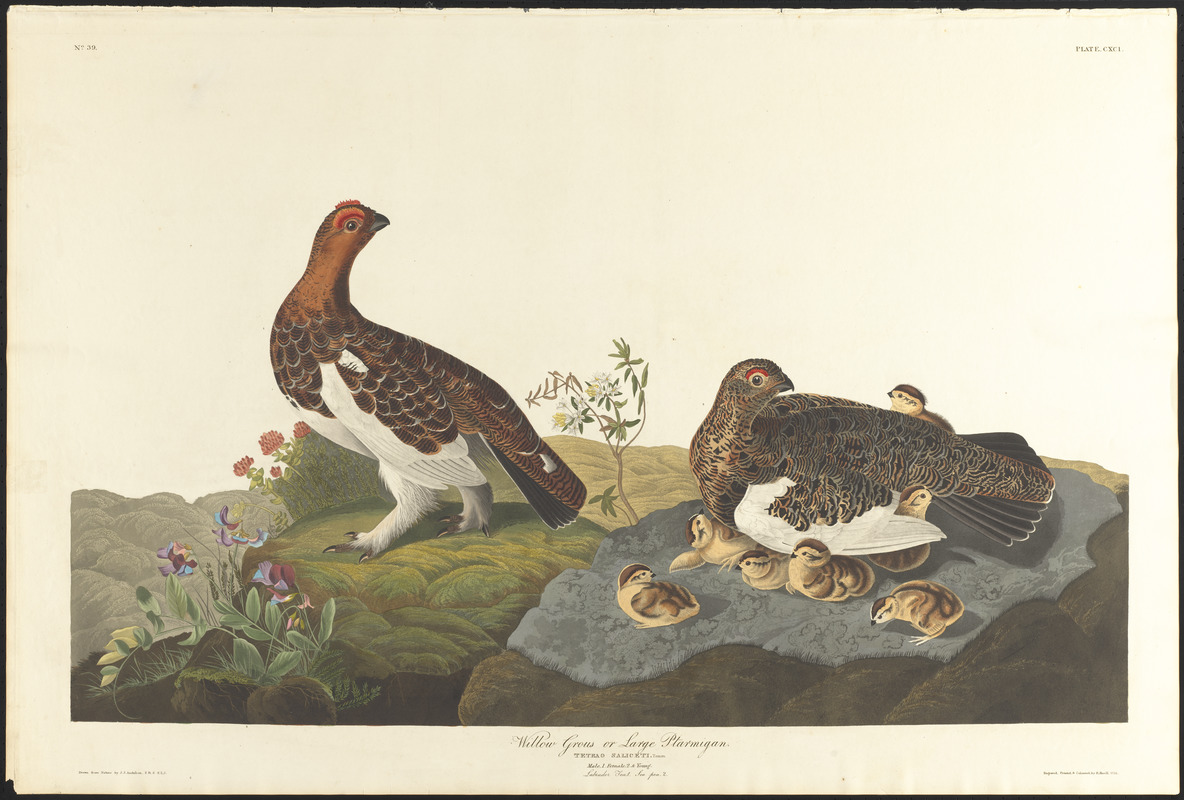
Through an examination of Volume I of Audubon and His Journal, which contains his Labrador Journal, the volumes of the Biography, and his published letters on this subject, I have been able to identify 23 of these 25 bird drawings.
As noted in his Letter (p. 243) seven of these 23 show up in the final plates in Volume 2, and all are identifiable and traceable to specimens collected by Audubon on this trip:
- Plate 191 (Willow Ptarmigan)
- Plate 193 (Lincoln's Sparrow)
- Plate 194 (Boreal Chickadee)
- Plate 195 (Ruby-crowned Kinglet)
- Plate 196 (Gyrfalcon)
- Plate 197 (Red Crossbill)
- Plate 200 (Horned Lark)
At the time that Audubon published his Ornithological Biography, there were few bona fide species records for the provinces of Quebec, New Brunswick, Nova Scotia and Newfoundland. Many of Audubon's records for species collected were thus first records for these provinces.
Bird drawings likely made by Audubon in Quebec
The birds known to have been collected, painted and described by Audubon during his expeditions to Atlantic Canada account for only a small percentage of the 200 bird specimens he says he collected on the Labrador trip. Twenty-five additional species recorded in his Labrador Journal and the Biography are attributable to his Atlantic Canada trips. He painted all of these birds after he completed his Labrador trip.
As one might expect there are a preponderance of seabirds and boreal species: Common Eider, Harlequin Duck, Surf Scoter, American Oystercatcher, Black-bellied Plover, Semipalmated Plover, Least Sandpiper, Greater Yellowlegs, Red-necked Phalarope, Great Black-backed Gull, Double-crested Cormorant, Northern Harrier and Pine Siskin. Although Audubon recorded all of these species in Quebec, and they may well have been collected there, none of his paintings can be specifically assigned to Quebec birds. Although specific birds were recorded, and were known to have been collected in Atlantic Canada, it is difficult to prove that these particular birds ended up being the subject of subsequent drawings. However, the predominance of attractive breeding-plumaged adults, which were appealing to an artist such as Audubon, and the fact that most do not breed in the United States, makes this very likely.
Other Audubon Quebec records
Of those species known to have been collected by Audubon in Quebec, the American Oystercatcher is a second first record for Canada. The Oystercatcher, and a Great Cormorant, collected and described (and possibly painted), also represent first records for Quebec. Audubon recorded the nesting of Piping Plover, Ring-billed Gull and Purple Finch. It is likely he collected specimens of all three species. While this is not certain, each represents at least the first record of their presence in the province, as does his sight record of American Black Duck.
While Audubon probably had mixed feelings about the success of the Labrador adventure, it marked an important moment in the history of Canadian ornithology. In 1833 knowledge of the birds in Atlantic Canada was almost exclusively local, with local bird names and an emphasis on those associated with hunting and fishing. Audubon's regional and comprehensive expedition brought together for the first time bird records from New Brunswick, Nova Scotia, the Quebec north shore and western Newfoundland.
In a wider Canadian context Audubon's ornithological expedition was the first whose mission was exclusively directed at collecting birds, although as Shattuck points out, the party was also on the lookout for new mammals and plant species. With six trained assistants in the field daily, Audubon was able to achieve a depth of coverage along the north shore beyond what one might normally expect.
Overall, Audubon's contributions to Canadian ornithology were substantial. In addition to collecting the type specimen for the Lincoln's Sparrow, he described eight new species which had not been recorded previously in Canada: American Black Duck, Great Cormorant, Virginia Rail, Piping Plover, American Oystercatcher, Ring-billed Gull, Rose-breasted Grosbeak and Pine Siskin. In addition, he used a large number of Canadian specimens in his paintings and observations in Biography.
An Assessment of Audubon the Ornithologist
Audubon associated with and was known to most of the prominent naturalists and ornithologists in his lifetime. He was a superbly gifted self-taught bird artist, and in that capacity he was widely recognized for his talent by most of the leading scientists.
Audubon had no specific training as an ornithologist. Todd was very damming in his criticism of Audubon. Since his Birds and his Biography were published at a time when ornithology had emerged as a scientific discipline, this criticism is justified. It is evident that Audubon had little understanding of systematics which was the preoccupation of contemporary ornithologists. He wisely left this aspect of his Biography to the English ornithologist, William MacGillivary.
Bibliography
- Audubon, John James. 1831 to 1839. Ornithological Biography Vol 1. Philadelphia: John Dobson, Vols 2. Edinburgh: Adan Black. Vols 3-5 Edinburgh: Adam & Charles Black
- Audubon, John James. 1827-1838. Birds of America. London: Audubon
- Audubon, Maria R. Edit. 1960 Audubon and His Journals, 2 Vols. New York: Dover Publications
- Corning, Howard edit. 1930. Letters of John James Audubon 1826-1840, 2 Vols. Boston: The Club of Odd Volumes
- Herrick, Francis Hobart. 2019. Audubon the Naturalist, A History of his Life and Time. 2 Vols On Line: Project Gutenberg https://www.gutenberg.org/files/58983/58983-h/58983-h.htm#Page_3
- Stresemann, Erwin. 1975. Ornithology from Aristotle to the Present. Cambridge MA: Harvard University Press
- Todd, Clyde. 1963. Birds of the Labrador Peninsula and Adjacent Areas. Toronto: University of Toronto Press
- Townsend, Charles W. 1918. In Audubon’s Labrador. New York and Boston: Houghton-Mifflin