Search
Regions
James MacPherson LeMoine
(1825-1912)
James MacPherson LeMoine was born into wealth and privilege. His father Benjamin LeMoine descended from a seigneurial family, while his mother, Julia MacPherson, was the daughter of United Empire Loyalists who acquired the seigneurie of Île-aux-Grues (Crane Island). LeMoine received a classical education and pursued a career as a lawyer and public servant. He lived most of his adult life at his residence Spencer Grange, near Sillery, in Quebec.
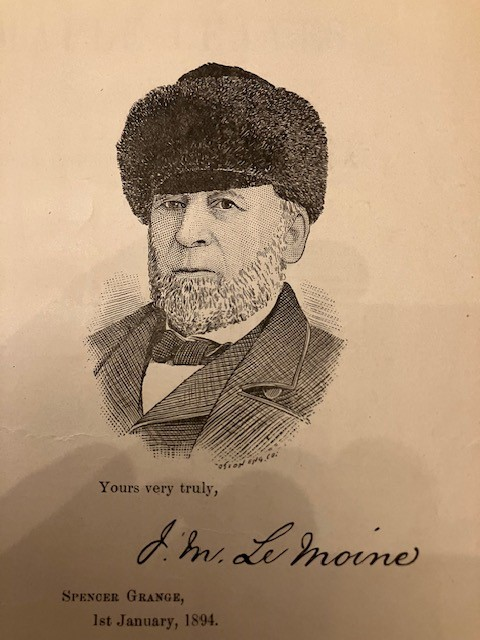 LeMoine, J. M. 1894. Sketch of James LeMoine. Maple Leaves. Quebec: L. J. Demers & Frere.
Over a lifetime LeMoine wrote extensively on Quebec ornithology. He began researching, reading about and observing birds from an early age, likely greatly influenced by his early exposure to the natural environment on Île-aux-Grues.
The publication of Baird’s The Birds of North America in 1858 encouraged LeMoine to write Ornithologie du Canada. As he notes in his Avant-Propos (Forward):
Une lacune existait dans le champ des lettres: le Canada avait ses orateurs, ses historiens, ses litterateurs, ses poètes, mais de naturalistes, point.
Translated into English:
There is a something missing in the field of letters: Canada has its orators, its historians, its writers, its poets, as to naturalist, none.
He also cites the experience of M. J. Maxham, a young Quebec medical student studying at the University of Edinburgh, who found that the Scottish university library possessed a superb collection of Canadian birds, better than anything he had seen in Quebec.
The first edition of Ornithologie, published in 1860, quickly sold out. This encouraged LeMoine to write a second revised edition published in 1861. This review of LeMoine’s significance to Quebec ornithology is based largely on the 1861 edition, which contains a more traditional species account than the rare, more eclectic,1860 edition.
Lemoine’s Canada
On reading Ornithologie it is evident that LeMoine’s “Canada” only included the united provinces of Quebec (Lower Canada) and Ontario (Upper Canada) known as “The Canadas”. (The provinces of Ontario, Quebec, Nova Scotia and New Brunswick united to form the confederation known as Canada in 1867.) LeMoine’s title, Ornithologie du Canada, while misleading to us today, is understandable.
For ornithological material from Upper Canada LeMoine relied on the published bird records of George Allan of Toronto, as well as Samuel Passmore May’s article on birds in The Handbook of Toronto, and on the early works of pioneering Ontario ornithologist Thomas McIlwraith. The first of McIlwraith’s extensive bird records from the Hamilton area were published in The Canadian Journal in 1860. It is not known if LeMoine and McIlwraith communicated with each other.
Ornithologie du Canada
LeMoine was a member of the Literary and Historical Society of Quebec (LHSQ), and the Montreal Natural History Society (MNHS). Both these natural history societies maintained extensive bird collections, but there are enough omissions from both collections to suggest that they did not form the basis for the Quebec records in Ornithologie.
LeMoine himself assembled a significant ornithological collection at Spencer Grange, which he used for some of his bird descriptions. He also made extensive use of his field notes from Quebec and from trips he made to Montreal, the lower St. Lawrence and the Gaspé. LeMoine also cites widely from the records of his contacts with observers and collectors in Quebec. In addition to a few references to Archibald Hall, an expert on the MNHS collection, he mentions, among others, correspondence with Dr Duquet in Rimouski and with John Strang and William Sheppard in Quebec.
Ornithologie represents LeMoine’s most significant ornithological work. It is a singular work which reflects the personal stamp of the author, a curious mix of the encyclopaedists, and historical and contemporary authors. As a result Ornithologie includes articles on falconry, discussion about birds from Aristotle to Aldrovandi, plus references to more contemporary naturalists and ornithologists including Gilbert White, Johann Bechstein, Alexander Wilson, John James Audubon and John Richardson. It is evident that LeMoine read many of these authors carefully. For example, he uses the Bechstein phonetics to describe the song of the Song Sparrow.
LeMoine also includes observations of early Quebec naturalists Leclerc, Le Jeune, Boucher and Charlevoix. Omitted are Sagard and Denys, and the most important source of early Quebec bird records, Brisson’s Ornithologie, published in 1760. Despite the omissions, LeMoine’s work adds an historical dimension missing from the publications of all other 19th-century Quebec ornithologists. LeMoine supplemented his written Quebec species accounts by the extensive use of descriptions, field notes and range information from the works of American ornithologists. LeMoine cites Vieillot, Wilson, Audubon, Cassin and Baird. For other Canadian records he relied on Richardson’s Fauna Boreali Americana 2: The Birds (1831).
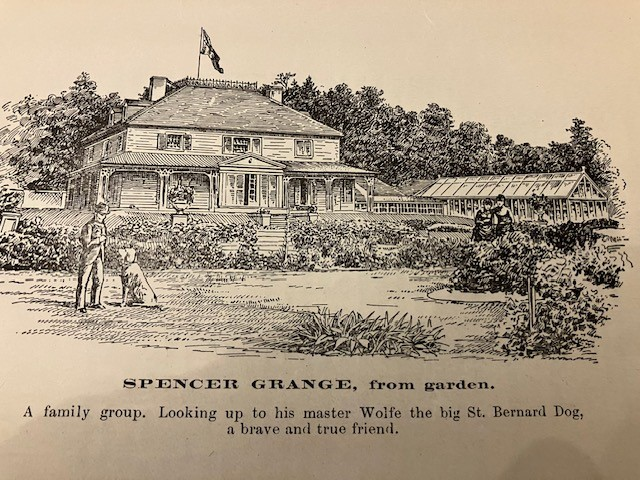 LeMoine, J. M. 1894. Sketch of Spencer Grange. Maple Leaves. Quebec: L. J. Demers & Frere.
LeMoine considered Audubon the most important ornithologist in North America. He used his impressive Ornithological Biography (of bird species) and quotes him extensively. The strong appeal of Audubon probably had personal historical associations. When Audubon visited Quebec City in 1842 to sell subscriptions to Birds of America he sought out wealthy businessman Henry Atkinson, who owned Spencer Wood. In 1851 LeMoine purchased 40 acres of Spencer Wood from Atkinson. In 1860 he married Atkinson’s niece and built Spencer Grange on the property.
Ornithologie was essentially a popular account of the birds of Ontario and Quebec, and the first significant ornithological work published by a resident Canadian. Most of LeMoine’s bird entries contain descriptions of the male and female bird, information on range, nesting, migration, calls etc. Many of the observations about migration dates and ranges are derived from his personal experience but his treatment can be hurried and inconsistent. In this sense, LeMoine’s work lacks the rigour of his ornithological contemporaries Archibald Hall and William Couper.1 Reading Ornithologie leaves the impression that LeMoine was strictly an amateur Quebec ornithologist and historian.
LeMoine’s work does provide insight into his connections with the ornithological community and reveals what he and his contemporaries knew about the abundance, migration patterns and distribution of birds, particularly in the Quebec area. His accounts of particular species, such as the presence of Golden Eagles at Lac Mephramagog and Night-Heron colonies at Ole-aux-Oies and Beauport, are important historical records. Using McIlwraith’s research and his own, LeMoine was likely the first Canadian ornithologist to recognize that temperature differences between southern Ontario and Quebec affected species distribution and overwintering.
Ornithologie lists 178 identifiable Canadian species, though lack of clarity about individual species status in Quebec is often an issue. Some examples:
- Canadian species that he does not specifically ascribe to Quebec include uncommon species, which no previous Quebec naturalist had mentioned, including:
- Stilt Sandpiper
- Curlew Sandpiper
- Wilson’s Phalarope
- Cooper’s Hawk, Barn Owl
- Short-eared Owl, Warbling Vireo
- Summer Tanager
- It is sometimes unclear from reading the text if LeMoine knew the bird had been recorded in Quebec or was merely guessing, based on its known presence in the Canadian Arctic and in the United States. Some examples include Killdeer, his discussion of the status of Screech, Saw-whet and Boreal Owls, and Hermit Thrush.
- In some cases, he states individual species are found in all of Canada without specific reference to Quebec.
LeMoine also provides useful information on the identity of the “Rossignol”, a bird widely mentioned in early Quebecois literature. While most species accounts amount to one or two pages, he devotes fifteen pages to the Song Sparrow. This bird is clearly beloved and has great meaning to Quebecers and is mentioned in virtually all accounts of early Quebec naturalists.
It is not surprising, given the limitations of Ornithologie as a combined work on the bird life of southeastern Canada and the fact that it was published in French, that it was little known and rarely cited by the predominately English-speaking ornithologists in the United States. This neglect also led to the virtual omission of the significant American ornithological work of Jean François Vieillot, leaving a large gap in Americans’ knowledge of their early ornithology.
Charles Dionne wrote his Catalogue des Oiseaux de la Province de Quebec in 1889. Catalogue is the second-most important scholarly work in Quebec ornithology after Archibald Hall’s 1862 article. It contains records of 273 species found in the province. It is significant to note that while Dionne includes records from contemporary naturalist William Couper, who resided mostly in Quebec between 1860 and 1884, no record from LeMoine is specifically cited.
Finally, LeMoine provides useful information on the identity of the “Rossignol” a bird widely mentioned in early Quebecois literature. While most species accounts amount to one or two pages he devotes 15 pages to the Song Sparrow. This bird is clearly beloved and has great meaning to Quebecers and mentioned in virtual all accounts of early Quebec naturalists.
LeMoine wrote many other articles on Quebec ornithology. Perhaps the most relevant is his Maple Leaves published in 1894. This volume contains a 45 page article “The Birds of Quebec”. A Popular Lecture Delivered Before the Natural History Society, at Montreal on 12th March, 1891.
Bibliography
- Audubon, John James 1831-1839. Ornithological Biography. Philadelphia: Judah Dobson
- Audubon, John James. 1827-1838. Birds of America. London: J. J. Audubon
- Baird, S. F, J. Cassin and G. B. Lawrence. 1858. The Birds of North America. Philadelphia: J. P. Lippincot & Co.
- Gosselin, M. 2014. “De Pierre Chasseur à Ernest Wintle: 110 ans d’oiseaux”. Québec Oiseaux, Spring, 2014
- Hall, Archibald. 1862. “Mammals and Birds of the Montreal District”. Canadian Naturalist and Geologist 4 &5. Montreal: Dawson Bros.
- LeMoine, J. M. 1859. “Notes on Land and Sea Birds observed around Quebec”. Canadian Naturalist and Geologist, Volume 4: Part 1. Montreal: B. Dawson
- LeMoine, J. M. 1861. Ornithologie du Canada, Second Edition. Part One. Quebec: J. T. Brousseau. Part Two. Quebec: E. R. Frechette
- LeMoine, J.M. 1882. Picturesque Quebec: a sequel to Quebec past and present. Montreal: Dawson Brothers
- LeMoine, J. M. 1894. Maple Leaves. Canadian History – Literature – Ornithology. Quebec: L. J. Demers & Frère
- McIlwraith, T. 1860. “List of Birds observed in the vicinity of Hamilton, CW arranged after the system of Audubon”. The Canadian Journal of Industry Science, and Art, New Series Vol. 5 No. 28, July 1860: 387-396. Toronto: Lovell and Gibson
- McIlwraith, T. 1861. “Notices of Birds Observed Near Hamilton, C.W.” The Canadian Journal of Industry, Science and Art, New Series Number 31, January 1861: 6-18; No. 32: 129-138. Toronto: Lovell and Gibson
- Dr Duquet of Rimouski PDF Document
-
Archibald Hall’s much more important work on Quebec ornithology “Mammals and Birds of the Montreal District” was written in 1839 but not published until 1862. It is evident in reading Ornithologie that LeMoine was aware of Hall but probably did not have access to the Hall manuscript, which was in the possession of American ornithologists at the time. This was particularly unfortunate for Canadian ornithology. If LeMoine had combined the content of the Hall manuscript, which encompassed an expansive area around Montreal, with his knowledge of the avifauna of the lower St. Lawrence valley in the Quebec area his contribution to early Canadian ornithology would have been more substantial. ↩