Search
Regions
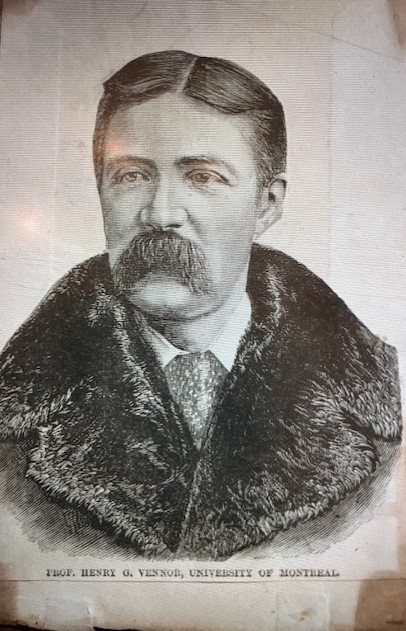
Henry George Vennor
(1840-1884)
Henry George Vennor Junior was born in Montreal, the son of Henry Vennor and Marion Peterson. His father was a prominent Montreal businessman, but details of Vennor family history are scant. A letter from Henry Senior to his wife in the McGill Archives, dated October 1866 reveals that they had three other children (BW MSS 012-11).
Henry Vennor, the naturalist, received his primary education at Philips School in Montreal, likely a small private school for the well-to-do (Muir 1981). He then attended a leading institution of the day, the High School of Montreal, founded in 1843. In 1846 the High School absorbed the Royal Grammar School (O’Donnell). The Grammar School was run for many years by the educator Alexander Skakel, one of the founders of the Montreal Natural History Society.
By 1853 the young Vennor was making extensive notes on geology in his journal. This interest led to his eventual career choice, employment with the Geological Survey of Canada. Vennor’s 1859 notebook, “Notes on Natural History” also showed an early interest in birds, and included a few pages on bird classification and a sketch of a Northern Flicker.
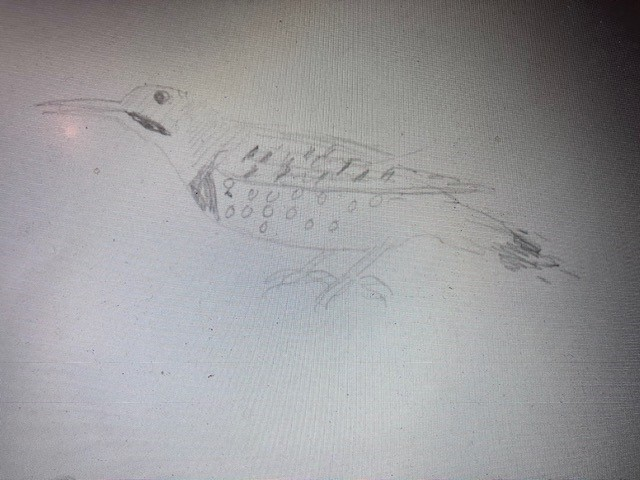 Sketch of a Northern Flicker (BW MSS 012-14)
Vennor entered McGill College in 1858 where he took a two-year course in applied sciences, a program initiated and taught by the prominent geologist Sir William Dawson. He graduated with an honours degree in Civil Engineering in 1860. While taking classes at the Feller Institute in the hamlet of Grand Ligne (near St Jean-sur-Richelieu) in July 1859, he wrote some observations on Passenger Pigeons in a “Field Notebook” (BW MSS 012-5):
Flocks of the Passenger Pigeons (Ectopistes Migratoria) have been passing for some days. Number in flock varying (from those I have seen) from 4 to 10 in the morning from 4 to 5 o’clock. They fly in flocks, during the day I have not seen them at all, although they must rest in the woods, during the heat of the day. In the evening they collect to eat the raspberries. When they rest for a time in the flights, they generally choose very high dead trees, or on the dead branches of large living trees.

In the mornings their cry is a sharp but mournful cry when flying, but when eating they utter the same note in a quick sharp manner. The pigeons were here much earlier last year, the cool protracted weather seems to have kept them back. Young pigeons are making their appearance.
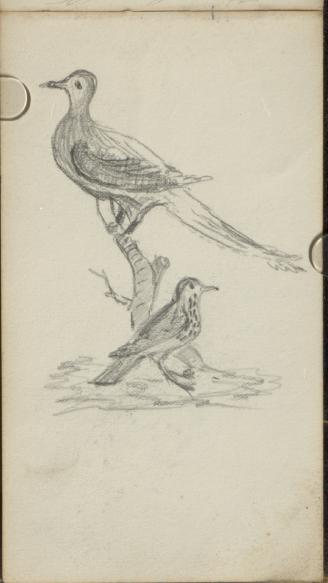 Vennor, H. G. 1859. Sketch of Passenger Pigeon and Wood Thrush (BW MSS 012-5)
Vennor’s “Notebook on natural history, Island of Montreal and vicinity 1858-1864” (BW MSS 012-9) was his main journal for entering his local field observations. His first entry on August 9, 1858 described a field trip to the Mile End quarries. His last entry was April 1864. Vennor’s favourite haunts, largely in search of birds for his growing collection, were Mount Royal, Nun’s Island and walking along the Lachine railway track (opened in 1847).
On graduating in 1860 Vennor accepted a position with the Montreal merchant company Fotheringham and Workman where he worked for the next five years. It is evident in reading his 1858-64 “Notebook” that his field trips were largely on weekends. Vennor invariably took to the field with his gun, occasionally a telescope, and a companion, often William Hunter, the curator of the Montreal Natural History Society, or one of his brothers. As a result, he spent more time on bird research, rekindled an interest in studying the weather, and expanded his collections of fossils and birds. He also relied much more heavily on Hunter to find new birds for his collection as well as his network of contacts, and bird specimens purchased at the Bonsecours Market in Old Montreal. He also patronized the multi-vendor fur market at Lachine.
On April 14, 1860 Vennor, the dedicated field-naturalist, wrote in his Notebook:
My collection of stuffed birds increases very fast. My whole attention & study time in that way. The taste I have always had for natural history was general but it now points to the feathered tribe solely. I am entering upon the study the vastness of which does not prevent me too much, just the threshold but something added to the history of our Birds. However little will never be amiss. We can boast of a powerful, noble if not the most beautiful feathered inhabitants as any other part of the globe...
Between 1860 to 1864 Vennor also wrote three articles about birds, two of which were published in the Canadian Naturalist and Geologist (CNG) and one in the British American Magazine. (See Bibliography) His article on the Night-heron (CNG: 1865) is of particular interest. It was a detailed examination of this species covering most aspects of its ecology. He also mentions the European and Indian species and briefly discusses whether the experts think these geographically diverse birds are the same species. Of local interest is his observation that the Montreal colony consisted of 80 to 100 pairs and was located at the west end of Nun’s Island.
In 1865 Vennor left his employment with Fotheringham and Workman to take up a temporary position as assistant to Sir William Logan, the founder of the Geological Survey of Canada (GSC), on a survey of Manitoulin Island and Lake Huron. The following year he was appointed to a permanent position with the Survey, where he remained until 1881 when he resigned to pursue other interests, including the founding of a weather almanac. He may have married in 1870 but his marital status is unclear. Some accounts suggest he never married, though others record a marriage to Mary Smith Wilkins (1845-1920) (Archives of Montreal BM 35). He may have had three children (Eakins DCB).
Throughout his years of employment, Vennor never lost his interest in birds. Blacker Wood MSS 012-6 - Ornithological Newspaper Clippings – includes a note by Vennor in the Montreal Witness, likely in 1865, entitled “The Birds of Canada” and suggests Vennor was assembling his bird research and records for publication.
We have been favored with some advance sheets of a pamphlet, to be published late this summer, entitled “Contributions to Canadian Natural History, containing lists of the animals and birds of Canada, with instructions for their collection and preservation”, by H. G. Vennor. Also the plants of Canada, with practical instructions for their preservation, by John Bell, M.A., M.D.

The lists of birds will prove very valuable to Canadian Students of Natural History, as they will be the most perfect yet published. The information from which they are compiled has been obtained from all parts of Canada; and, before completing them, the author intends to add the results of another year of another season’s rambles in the wooded districts of Canada.
This work was never published. The surviving Vennor unpublished bird notes and published bird articles provide evidence that Vennor was laying the groundwork for a Birds of Canada. There is evidence in the final twenty pages of the 1859 “Notebook”, where Vennor lists 133 North American species, that he was assembling bird records. With Confederation in 1867, the idea of writing a Birds of Canada would have been a daunting task for any ornithologist. In the end he settled on a detailed study of Canadian raptors published in 1876 as Our birds of prey, or the eagles, hawks and owls of Canada, with photographs of all species by the renowned Montreal photographer William Notman. This work is by far his most important published work. He notes in his introduction:
The Natural History of Canada has received a very fair share of attention from Naturalists both at home and abroad, but in no one department of this fascinating study can the ground yet he said to be well trodden. In commencing work in this field some thirteen years ago, I chose as a special object of investigation our Birds of Prey, as affording a field perhaps less trodden than others.
The text is a thoroughly researched account of what was known of each species of raptor, and is firmly in the tradition of Canada’s most important 19th-century published ornithological work, British naturalist John Richardson’s Fauna Boreali Americana, Vol 2: The Birds, published in 1831. Vennor’s Our Birds of Prey is an impressive work combining the best of American behavioural research with a serious attempt to include observational and range material from the writings all the known ornithologists working in Canada. Given the complete absence of important ornithological books written by Canadians and published in Canada up to 1876, Our Birds of Prey belongs on the bookshelf of all Canadian ornithologists.
Vennor’s ornithological writings are an important early source of information about the places he visited in mid-19th century Montreal. This is particularly the case with his records of the earliest bird and breeding records for Mount Royal and Nun’s Island. His writings mention other Montreal naturalists of the period, including a close working relationship with another important mid-19th century Quebec naturalist-ornithologist, William Couper. Vennor’s writings reveal a bird collection of 145 species. The Redpath Museum has a small collection by early Montreal naturalist, Michael McCulloch (c1797-1854), but the fate of the Vennor collection is unknown at this time.
Bibliography
- Eakins, P. K. “Vennor, Henry George”. Dictionary of Canadian Biography https://www.biographi.ca/en/bio/vennorhenrygeorge_11E.html
- McGill University. Manuscripts and Special Collections, CA RDB BW MSS-012-1 to 12-15. Henry Vennor Collection
- McGill Faculty of Engineering online https://www.mcgill.ca/engineering/about-us/our-history/1811-1899
- Mount Royal Cemetery: Mary Smith Vennor https://www.findagrave.com/memorial/108968086/mary-smith-vennor
- Muir, Nathan H. 1981. Protestant Education in Quebec. Quebec: Conseil superior de l’education
- O’Donnell, Brendan. Bibliography of English-speaking Quebec https://quescren.concordia.ca/en/resource/MA7IMYY6
- Vennor, Henry George. 1860. “Notes on birds wintering in and around Montreal; from observations taken during the winters of 1856–57–58–59–60,” The Canadian Naturalist and Geologist 5: 425–30. Montreal: Dawson Brothers
- Vennor, Henry George. 1861. “A short review of the Sylviidae or Wood Warblers found in the vicinity of Montreal,” The Canadian Naturalist and Geologist 6: 349-362. Montreal: Dawson Brothers.
- Vennor, Henry George. 1864. “On the feathered songsters of the island of Montreal,” British American Magazine 2: 606–10. Toronto: Rollo and Adam
- Vennor, Henry George 1865. “A Few Notes on the Night-Heron,” The Canadian Naturalist and Geologist, New Series, Vol 2: 53-56
- Vennor, Henry George. 1876. Our birds of prey, or the eagles, hawks and owls of Canada. Montreal: Dawson Brothers