Search
Regions
Charles Fothergill
Charles Fothergill in Quebec 1816-1817
Charles Fothergill (1782-1840) was the most important ornithologist living in Canada in the first half of the 19th century. He emigrated from Liverpool, England in July, 1816. After a two-month voyage he arrived at Quebec on September 6, 1816. Fothergill’s passage took him along the south coast of Newfoundland, through the Cabot Strait and into the Gulf of St. Lawrence, and his ship appears to have stopped as well at Anticosti Island. Fothergill described the trip in his manuscript “Voyage from Liverpool to Quebec, 1816”. This is one of many unpublished Fothergill manuscripts discovered in the 20th century by the noted Ontario ornithologist and curator, Jim Baillie.
Fothergill passed through Quebec on his way to Ontario to take up a land grant near Port Hope. In January 1817 he was in Montreal, where he met a “Mr. Hall” who shared his interest in natural history. This may have been American-born Jacob Hall, one of four brothers who emigrated to Montreal after the American Revolution. Jacob was the father of Dr Archibald Hall who in 1839 wrote an important manuscript on the bird collection of the Montreal Natural History Society.
In early February Fothergill left Montreal by sleigh, passing through Les Cedres on February 8, and arriving in Ontario the following day. Fothergill established himself as a businessman, politician and publisher in Toronto. He never returned to Quebec. His career as a Canadian ornithologist is associated with Ontario where he studied the bird life for the next 23 years until his death in 1840. He scientifically described 147 bird species, many of them first records for Ontario and Canada.
Fothergill’s Quebec bird records are all from the St Lawrence or the Quebec area and date to 1816-17. His observations and collecting are important in the early history of Quebec ornithology. Between 1760 and 1820 the only other ornithologist of consequence was the British army officer, artist, and collector, Thomas Davies (c1737-1812). Davies was posted to Quebec between 1786 and 1790 but never published his records. His Quebec bird records can be found in the published works of his close associates, British ornithologists Thomas Pennant and John Latham, who described about 20 species collected by Davies in Quebec.
Unfortunately, Fothergill also did not publish his observations in Quebec. Most of Fothergill’s Quebec records can be found in a list of birds contained in an alphabetical Index he prepared in the late 1820s for his Memoirs and illustrations of natural history in various parts of the British Empire. This manuscript was never published and is known today as the Clendenan volume.
One of the birds on the list he called the “Golden-crowned Povoine”. A later description of this bird, which we now know as the Chestnut-sided Warbler, can be found in a companion volume known as the McGillivray manuscript (p.229). Included in his description are some interesting notes:
There is a very beautiful family of small insectivorous birds that are neither titmice nor warblers i.e. I mean Pari or Mottiacillae, which inhabit the Canadas that for the present I shall name Povoines after the Provincial [Quebec] name mentioned by a Pilot from Father Point for the bird caught on board the William in the St. Lawrence on my voyage to Quebec in 1816, and which I painted from the life and described in the journal of my voyage with sufficient exactness immediately on shews.

That bird to the Pilot on board he named it. The word Povoine in French means a "gnat catcher" which is very appropriate for all the birds which I shall place in this family the principal character of which is the formulation of the bill which is longer and straighter than the Pari and beset with bristle.
(For transcriptions of all Fothergill’s bird observations, see my transcriptions of Fothergill’s bird records, Birds of Upper Canada, 1840 in the section on 19th-century Ontario also on this website.)
Regrettably, Fothergill’s painting of the Chestnut-sided Warbler, like almost all of his extensive collection of artworks, has never been found.
Quebec bird records can also be found in the interleaved pages of Fothergill’s copy of Bewick’s British Birds. In total I have identified 23 Quebec species in various Fothergill writings as follows:
- Clendenan (13)
- McGillivray (4)
- Bewick (6)
Nine Quebec birds in the Clendenan list: a gull, some terns, a phalarope, two shorebirds from Anticosti etc are given vernacular names. They are not identifiable at species level.
Fothergill’s most interesting Quebec bird records are found in the McGillivray manuscript. In addition to the Chestnut-sided Warbler, he listed:
- Cinereous Godwit (Greater Yellowlegs)
- St. Lawrence Povoine (Red-breasted Nuthatch)
- Golden-vented Wren (Warbler species)
- Ash-coloured Finch (Dark-eyed Junco)
The most complete description of birds Fothergill collected in Quebec is that of a pair of Greater Yellowlegs. His detailed description, not transcribed here, is followed by some interesting notes:
Of a pair shot on the river St Charles called [indecipherable name] by the Indians on account of the numerous curvatures of its channel above the falls of La Jeune Lorette October 10th 1816, I could perceive no difference whatever except that there was a little more white on the upper tail coverts on one specimen than in the other. The Canadians about Quebec for want of a more apt knowledge, call this bird a woodcock. It is not infrequent in the market of Quebec in the autumn and the bird cannot be said to be uncommon in Lower Canada although it ranks among the most rare of British Birds......I found them exquisite eating but being considered and named Woodcock by the Canadians their cooks generally dress them with tail in on a toast which spoils the birds –
Fothergill intended to publish his writings in a four volume set entitled Birds of the British Empire. He prepared considerable artwork for these unpublished volumes that has been mostly lost. The finest artwork that has survived is his Red-breasted Nuthatch, rendered from a bird he collected on board the William in the St. Lawrence River on his way to Quebec.
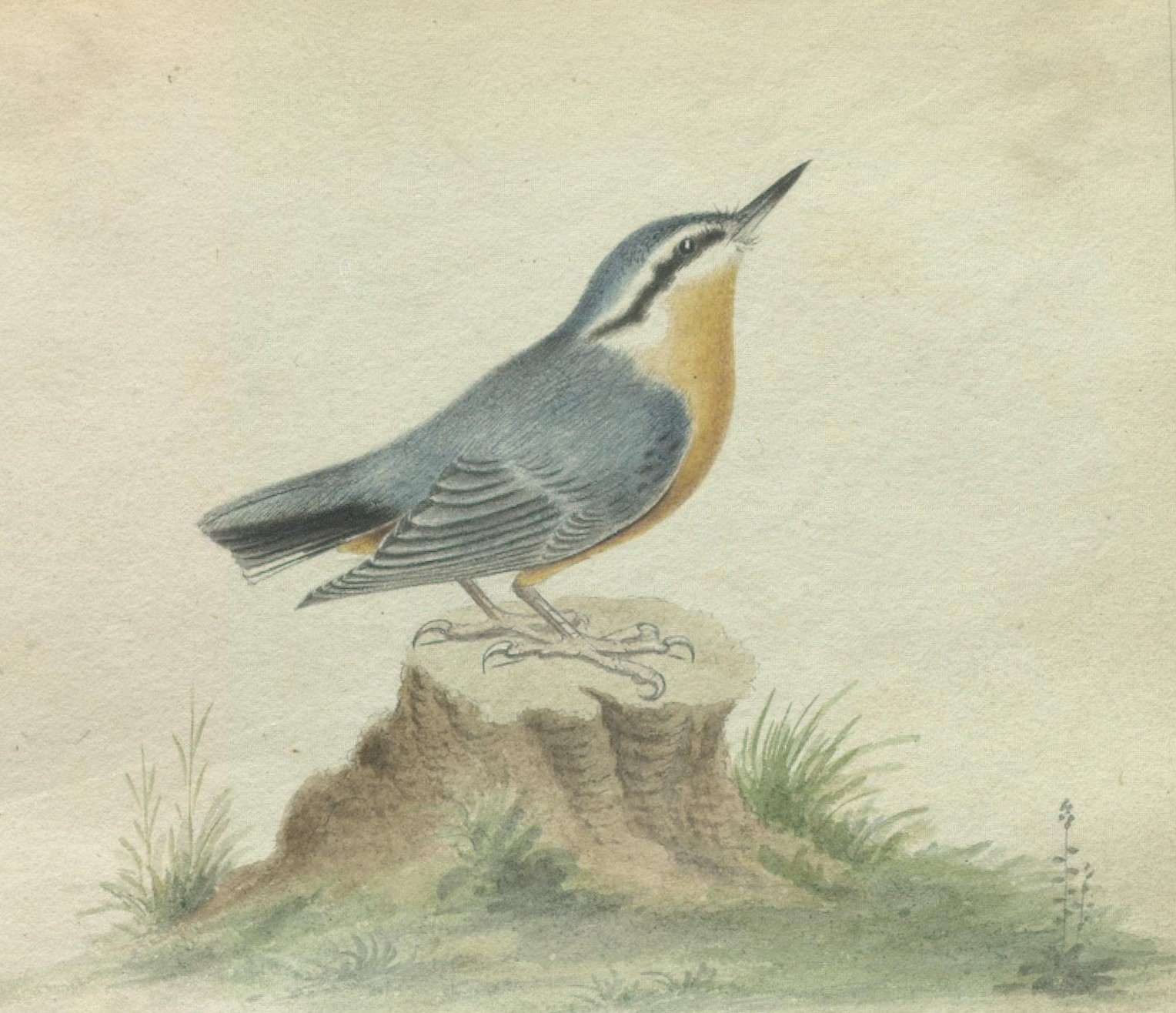 St. Lawrence Povoine (Red-breasted Nuthatch) August, 1816. McGillivray Manuscript (p. 247).
Another watercolour has also survived. Ash-coloured Finch (Dark eyed Junco) was collected at the mouth of the Chaudiere River in Quebec on September 29, 1816. He may have described it at the time but the description and artwork that has survived is from a bird collected in Ontario.
Six bird records were found in Fothergill’s copy of Bewick’s British Birds:
- Rock Pigeon
- Common Murre
- Razorbill
- Purple Martin (which Fothergill called the Great Black Martin)
- Bohemian Waxwing (Waxen Chatterer)
- American Pipit (Rock Lark)
The Rock Pigeon record is notable. A drawing of a dovecote appears in early works from Champlain’s settlement at Port Royal (Nova Scotia). Despite the early introduction of his bird, which was traditionally raised in France and New France for food, Fothergill’s listing may be the earliest record from Quebec and Canada.
Finally, in his unpublished manuscript entitled Natural History Notes (p. 32) ascribed to the 1839-1840 period, Fothergill notes the range of the Bohemian Waxwing:
William P. Smith, Ornithologist, has killed this bird in the neighbourhood of Quebec. A few also are occasionally seen in the Upper Province [Ontario] but is more rare here than lower down or more towards the north-east.
William Patrick Smith assembled a massive early collection of Canadian birds during this period.
Fothergill also mentions Purple Martins at Quebec and Montreal, the latter location record most certainly provided by Hall.
Bibliography
- Fothergill, Charles. 1816. Voyage from Liverpool to Quebec, 1816. Unpublished Manuscript. Toronto: Thomas Fisher Rare Book Library, University of Toronto Manuscript Collection #140. Volume 19
- Fothergill, Charles. 1816-1821. Canadian researches chiefly in natural history. Vol 1st, 1816-1821. Unpublished Manuscript. Toronto: Thomas Fisher Rare Book Library, University of Toronto Manuscript Collection #140. Volume 20. McGillivray Manuscript
- Fothergill, Charles. 1830-ca-1837. Memoirs and illustrations of natural history in various parts of the British Empire. Unpublished Manuscript. Toronto: Thomas Fisher Rare Book Library, University of Toronto Manuscript Collection #140. Volume 25. Clendenan Manuscript