Search
Regions
Charles-Eusèbe Dionne
(1846-1925)
Normand David, who recently passed, was awarded the Charles-Eusèbe-Dionne Prize by QuébecOiseaux in 2006 for his life-long contribution and commitment to the development of ornithology in Quebec. This paper provides a background explaining the importance of Dionne to Quebec ornithology.
Charles-Eusèbe Dionne (1846-1925) was born in humble conditions in Saint-Denis de-la-Bouteillerie, a village on the south shore of the Saint Lawrence, between Rivière-Ouelle and Kamouraska. He was the eldest son of Eusèbe Dionne, a shoemaker, and Emélie Lavoie.
It is fitting that it was Normand selected to write Dionne’s biography in the Biographical Dictionary of American and Canadian Naturalists and Environmentalists. Normand notes that Dionne’s interest in birds started in childhood:
He attended elementary school in St-Denis (1853-1859). His interest in natural sciences was already apparent at this age. [He] carved wood sculptures of common birds, which he also attracted by the imitation of their song. At age eleven [he] mounted the first specimen in his collection.
Normand also noted that between 1862 and 1864, on account of his natural curiosity, Dionne was permitted to attend lectures at a local private school.
In 1865 Dionne moved to Québec where he secured a job as a handyman at the Séminaire de Québec. Dionne had a strong desire to improve himself, and with the help of the priests, who administered Laval University, he was able to secure a position in 1866 as a laboratory attendant at the Faculty of Law. There he had access to the university library which offered him an opportunity to satisfy his voracious appetite for the study of natural history.
During this period he took up taxidermy as a hobby. Under the guidance of Abbé Léon Provancher he developed a strong interest in entomology and a wider interest in natural history. During the 1870s Dionne also gained a reputation within the university for his dedication to scholarship and natural history. In 1872 he was appointed an Assistant Librarian, and ten years later, in 1882, Curator of the Zoological Museum, a position he held until his death in 1925.
Dionne devoted himself to enhancing the museum’s collections and putting them on display. For his work he was given an honorary MA in 1902, and later awarded an Honorary Doctorate.
Throughout Dionne’s career he maintained his strong interest in ornithology, which culminated in the publishing of Les Oiseaux du Canada in 1883, his Catalogue des Oiseaux de la Province de Québec in 1889, and Les oiseaux de la province de Québec in 1906.
Les Oiseaux du Canada (1883)
Dionne dedicated Les Oiseaux du Canada to Abbé Provancher. In his Preface he discusses the wonder of birds and outlines his reasons for attempting a work covering all of Canada. He cites the many important publications to date but noted that numerous were out of print or not available and that new information was always being discovered. Dionne also wanted to address the lack of information on Canadian birds available in French.
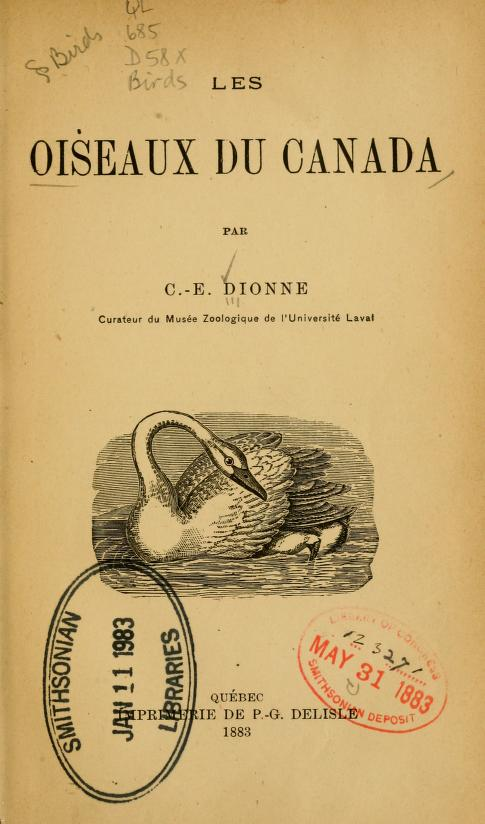 Dionne Les Oiseaux du Canada. 1883. Cover. Courtesy of the Biodiversity Heritage Library
Dionne discussed 343 species of birds attributed to Canada, but admitted that his work on Canadian bird records was, however, incomplete. Most published records from the provinces of Manitoba and British Columbia were not included. Records from the territories of Saskatchewan and Alberta were also largely excluded. He also included few records from eastern Canada. Dionne also relied on the classification system of Elliot Coues.
Dionne listed the publications he consulted but unfortunately, he was unaware of or did not have access to two of the key published works on Canadian ornithology: Swainson and Richardson’s Fauna Boreali Americana 2: The Birds (1831), the most important 19th-century work of Canadian ornithology; and Archibald Hall’s “On the Mammals and Birds of the District of Montreal” written in 1839 and published in the Canadian Naturalist and Geologist in Volume 6 (1861) and Volume 7 (1862). Hall was also a key 19th-century work on Quebec ornithology.
A review of Dionne’s Oiseaux du Canada by well-known Canadian ornithologist, Montague Chamberlain, in the Canadian Sportsman and Naturalist 3: 248-252 in 1883 pointed out that Dionne’s use of most of the key sources was minimal, and that Dionne’s reliance on Malcolm Ross’s The Birds of Canada (1873) for non-Quebec Canadian content was also problematic. Chamberlain summed up his assessment:
It would take a large volume to point out all the errors which these two authors have made. I have picked out these few quite at random, but they will suffice to show how little reliance can be placed in anything which the books contain. Had they been content to publish what they had observed, or could have compiled from authentic sources, these writers would have rendered a valuable service to Canadian students and ornithologists at large, but the publication of these books must bring a blush to the cheek of every Canadian who realizes that those claiming to be eminent among our scientists are responsible for such miserable failures. It is time such work was stopped.
While his work was well-received in Quebec, Dionne took the criticism to heart. One of his biographers, Victor Gaboriault, suggested that Dionne felt the force of Chamberlain’s remarks and profited by them (“Dionne sentit le bien fondé de ces remarques et les mit à profit”).
Though much of Chamberlain’s criticism is justified, particularly his dismissal of the obsolete Coues classification system, his harsh tone may have been partly the result of a jealous concern for his own work. He published Catalogue of Canadian Birds in 1889.
In summary Dionne discusses over 264 pages 343 species of birds attributed to Canada. In the end the value of Oiseaux might lie in Dionne’s inclusion of comment on the Quebec status of the birds discussed. Unlike James LeMoine, who cited the records of 17th- and 18th-century Quebec naturalists in his Ornithologie du Canada (1860, 1861), Dionne used contemporary records and his own personal experience. His lack of research of Quebec records is, however, somewhat disappointing.
As suggested by Gaboriault, the criticism directed at Oiseaux du Canada encouraged Dionne to produce his next work, the Catalogue, devoted to Quebec birds.
Catalogue des oiseaux de la province de Québec - avec des notes sur leur distribution géographique (1889)
The Catalogue is a much more tightly focused work, and as Marianne Ainley notes, it “was much more thorough and was organized along lines suggested by Chamberlain in 1883”. Gone is the dedication, the Preface is shorter, and Coues’ classification system is replaced with Dionne’s use of the American Ornithologists’ Union (AOU) classification system. The Catalogue contains an annotated list covering 267 species recorded in Quebec, by far the best effort to date to provide a scientific Checklist of the Birds of Quebec.
Dionne’s new approach provided a much shorter text, illustrating a scientific approach, and greater effort to provide details on initial describers, as well as information on where and when birds were collected or observed, and who collected them.
The Catalogue was reviewed in The Auk 7 (1890) by the American ornithologist Charles Foster Batchelder (1856-1957) who wrote:
Dionne's Catalogue of the Birds of Quebec —
The writer modestly expresses a hope that his work will be of some use as a guide to the young ornithologists of Quebec. This is evidently its chief purpose, and is one that cannot fail to be amply fulfilled. The Catalogue follows the classification and nomenclature of the A. O. U. Check-List, and gives also — as an aid in reference to earlier writers — the names and numbers borne by each species in the check-lists of Baird, Coues, and Ridgway. Following this comes a generalized statement of the bird's distribution, adapted from the A. O. U. Check-List, together with information as to its occurrence, abundance, times of appearance, etc., in the Province of Quebec … It is to be regretted that in recording rarities Mr. Dionne does not always give full particulars and, in some of these cases, that the specimens were not identified by some ornithologist of unquestionable authority. The author justly regrets the scantiness of the data at his command, and, doubtless, more field work in his own neighborhood would have led him to change some statements, especially as to the abundance of certain species. Nevertheless he gives us much valuable information, and a book that promises to serve so well the purpose for which it was written may well be spared too searching criticism. — C. F. B.
Les oiseaux de la province de Québec (1906)
The 1906 publication of Dionne’s third volume on birds - Les oiseaux de la province de Québec - was the culmination of close to 50 years study of Quebec ornithology. It contains detailed accounts of 279 species and sub-species. Normand David remarked on its singular importance: “At the height of his career [Dionne] wrote Les mammifères de la province de Québec (1902) and Les oiseaux de la province de Québec (1906). Quebec became one of the few political divisions in North America covered by “state books”, on both mammals and birds.”
Other naturalists such as John James Audubon, Archibald Hall and James LeMoine all made significant contributions to 19th century Quebec ornithology, but as David said, “For many decades, Dionne’s French-speaking compatriots turned to Les oiseaux de la province de Québec (1906) as the standard reference on the birds of Quebec. It contains original notes on status of birds at the turn of the century that remain an invaluable source of information.”
While David noted that Dionne did not undertake original research but he “was a meticulous compiler of life histories, descriptions, and distributional occurrences… Both learned naturalists and laymen found him always ready and willing to answer their queries.” It was the unstinting and singular passion of Charles-Eusèbe Dionne that pioneered ornithology in 20th-century Quebec.
Bibliography
- Ainley, Marianne Gosztonyi. 1985. From Natural History to Avian Biology: Canadian Ornithology 1860-1950. Unpublished Thesis. Montreal: McGill University
- Batchelder, C. F. 1890. “Dionne’s Catalogue of the Birds of Quebec”. The Auk 7: 387. New York: L. S. Foster
- Chamberlain, Montague. 1883. “M. Dionne Les Oiseaux de Canada”. The Canadian Sportsman and Naturalist 3: 248-251. Montreal: Self-published
- David, Normand. 1997. “Dionne, Charles-Eusèbe” Biographical Dictionary of American and Canadian Naturalists and Environmentalists. Westport Connecticut: Greenwood Press
- Dionne, Charles-Eusèbe. 1883. Les Oiseaux du Canada. Québec: Imprimerie de P-G Delisle
- Dionne, Charles-Eusèbe. 1889. Catalogue des Oiseaux de la Province de Québec. Québec: J. Dussault
- Dionne, C-E. in Wikipedia. https://en.wikipedia.org/wiki/Charles-Eus%C3%A8be_Dionne
- Gaboriault, Victor. 1947. Bibliographie de Charles-Eusèbe Dionne. Montréal: École des bibliothécaires de l’Université de Montréal
- Ouellet, Henri. 2000. “Dionne, Charles-Eusèbe”. Dictionary of Canadian Biography 15 (1921-30). Toronto: University of Toronto Press
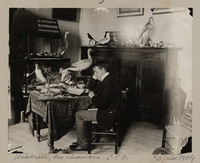 Charles-Eusèbe Dionne with some of his bird collection. Laval University.