Search
Regions
Louis Nicolas
Unequalled among 17th-century ornithological histories of Quebec and Canada is the work of the Jesuit, Louis Nicolas (1634-c1690). Recognition of the prominence of Nicolas’ work is of very recent origin. Prior to the mid-1980s, his 197-page manuscript on the natural history of New France, L’histoire naturelle des Indes occidentales, was unattributed in the collections of the Bibliothèque nationale de France. His companion work, known as the Codex Canadensis, containing 79 drawings of flora and fauna, had been published and erroneously ascribed to Quebec-born, Charles Bécard, Sieur de Grandville (1675-1703). The Codex passed through various owners, including Louis XIV, and after the tumult of the revolution went through many hands before being published in 1930in Paris by the Maurice Chamonal bookstore. The manuscript of the Codex was eventually acquired by the Thomas Gilcrease Institute of American History and Art in Tulsa, Oklahoma.
Nicolas’ work was brought to light by François-Marc Gagnon (1935-2019), one of Canada’s most respected art historians, who focused on the painters and sculptors of New France, and Quebec artists like Borduas, Riopelle and Molinari. Gagnon’s interest in New France led to his examination of the artwork in Codex. The recognition of Histoire and Codex as both works of Louis Nicolas led to Gagnon’s publication of The Codex Canadensis and the Writings of Louis Nicolas (2011), in collaboration with Réal Ouellet, who translated Nicolas’ text into modern French, and Nancy Senior, who provided the English translation.
This paper provides a brief summary of this book, which represents the first important work in Canadian ornithology. Nicolas’ fantastical sketch of a Pileated Woodpecker in Codex, presented below, is arguably the most iconic image in 17th-century Canadian ornithology.
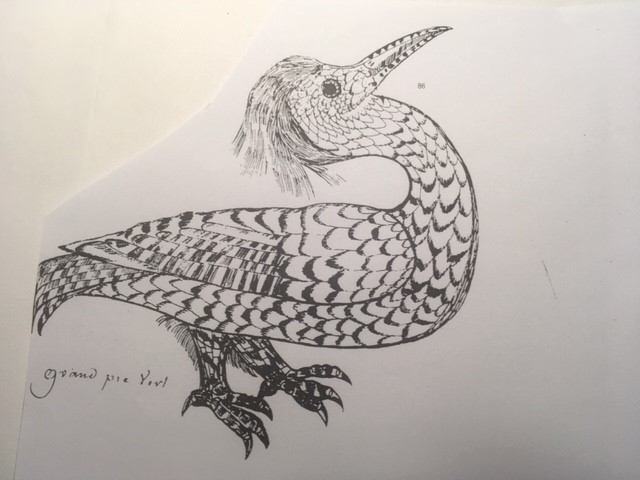
Louis Nicolas was born in 1634 in Aubenas, a town about 150 kms northeast of Montpellier. He entered the Jesuit order in Toulouse in 1654. (Daviault 1994). Nicolas was ordained in 1663 and sent to New France to conduct missionary work among the aboriginal people, arriving at Quebec in 1664. Over the next ten years he resided in diverse settlements from Sept-Iles to Ashland, Wisconsin. Nicolas returned to France about 1675. It is not clear when he died but it was probably in the late 1680s or early 1690s.
During his ten-year residence Nicolas ranged widely across New France recording birds and wildlife he encountered. He specifically mentions seabird and heronry sites well known to us today including Iles aux Oiseaux (Bird Isles) down river from Anticosti Island, the egg islands at Sept-Iles, Pointe aux Alouettes near Tadoussac, Cap aux Oies and Isles aux Coudres, and the Ile aux Hérons at the Lachine Rapids at Montreal. At each of these famous birding sites he describes the breeding or migrant fauna in sufficient detail to enable identification today.
It is likely Nicolas wrote Histoire during his residence in New France. The Codex, however, contains sketches copied or adapted from texts of medieval artists only available to Nicolas after his return to France. Histoire demonstrates Nicolas’s knowledge of classical Greek and Roman authors and reveals previous knowledge of and interest in European birds. Many of the names Nicolas used for his birds in Histoire are different from those used for the same birds in Codex. The interval between writing of the Histoire and Codex likely accounts for the discrepancy between bird names he used in the two works. In addition, as best as can be determined, there are about 10 species discussed in Histoire for which no sketch is provided in Codex, and at least nine sketches in Codex for which there is no text in Histoire.
The marrying of Louis Nicolas’ text and images help to fill the gaps in our knowledge of 17th-century European writing about natural history in Canada. Nicolas’ Histoire is arranged in four major sections: plants; mammals; birds and insects; and fish and other water animals. His discussion of birds covers 36 pages and includes 40 birds individually described in detail.
Nicolas’ observations are considerably more significant than those of 17th-century naturalist Nicolas Denys (c1598-1688). Denys, who lived in Acadia, is the most widely cited by early historians of ornithology in New France. Out of 45 species of identifiable Denys birds, only seven are discussed in any detail. Histoire is a more organized and scientific effort. The birds described by Louis Nicolas in the 1670s represent the first important descriptions of a number of bird species in Canada.
The bird accounts in Histoire are divided into three chapters (Books) which cover 36 pages. This separation reflects Nicolas’s form of classification. Book Nine describes land birds (16 pages), Book Ten birds of prey (13 pages), and Book Eleven waterbirds (7 pages). As was common in the period, Nicolas’ selection of birds for discussion relies primarily on their use to people. This accounts for inclusion of the birds of prey, including a discussion of falconry, descriptions of edible land birds, and waterfowl. Gagnon notes that Nicolas’ discussion of falconry is the centrepiece of his discussion of terrestrial birds:
...perhaps it will not be hard to place them in the middle of this treatise on birds, so that, by describing river birds at the end of the treatise on birds, they can seize as many as they can with their talons ... on the land, on trees and on the surface of the water (p.144)
Waterbirds were more likely to be discussed if they were larger. Nicolas suggests he knew many others. He lists numbers of species by generic group including:
- 3 or 4 chevaliers (long-billed shorebirds)
- 4 or 5 becassines (sandpipers)
- 4 or 5 pluviers (plovers)
- more than 15 species of plongeurs (diving waterfowl).
He subdivides the diving ducks into categories such as:
- ‘des grand canards noirs’ (scoters)
- ‘des becs de scie’ (literally sawbills)
- ‘communs’ (small diving ducks)
- ‘des becs de scie plus grands’ (larger diving ducks)
- ‘autre becs de scie encore plus grands’ (probably mergansers)
The birds were likely brought to Nicolas by Indigenous hunters. He ate many as he often mentions how they taste and how to cook them. Unlike most writers of the period, Nicolas also showed an interest in non-game land birds, which may have caught the eye of the hunters because of their beauty (goldfinch, scarlet tanager, bluebird, bobolink), because they were very common (chickadee), or for their uniqueness (hummingbird). Like everyone before him and most Canadian observers into the 18th century, he does not mention the vast majority of families of small birds such as sparrows, thrushes, warblers, vireos and flycatchers.
Although he provides no measurements, he arranges the birds he discusses in detail in order of size. Thus, his first land bird is the “l’oiseau-mouche” (Ruby-throated Hummingbird) and the last is “le coq d’Inde” (Wild Turkey). This practice allows contemporary ornithologists to identify most of the birds.
Nicolas regularly compares Canadian birds to those he knew in France. Discussing his ‘ortolan’ (Bobolink), for example, he notes “Le plumage, le gout, le chant sont tous différents du notre (our bird – perhaps Ortolan Bunting), et cet oiseau est assez rare dans le pays. It est blanc, gris, noir, jaune etc. It est de même corsage [body size] que ceux de ce pays [France].” Unlike other observers in the 16th and 17th century, Nicolas’ writings suggest that he did not assume that the birds were the same. He was more likely to note similarities.
Nicolas’ individual descriptions of birds are eclectic. He failed to use a more encyclopedic approach, which might have resulted in a common format. As a result, the locations where he saw birds, the habitat, resident or migratory status, size and field comparisons with European birds, food habits, edibility, nesting sites, etc. are presented in a piece-meal fashion for many species. His sketch of the ‘Chete’ in Codex and description in Histoire leaves no doubt that he saw the White Pelican, likely around Ashland near Lake Superior. On the other hand, a sketch of a Bobwhite in Codex is not described in Histoire.
Nicolas describes in some detail the remarkable tree nesting habits of Wood Ducks. He also notes that the young leave the nest and reach the ground on the back and wings of the parents. One might be forgive this rare slip. Unlike Denys, who was not above embellishing his wildlife accounts to assist in the sale of his books, Nicolas was a much more serious naturalist who saw his work as a genuine contribution to science.
Nicolas was enthralled with the Passenger Pigeon (du biset sauvage). A small quote from his extensive text is fairly typical of his interesting writing style: “This bird passes through twice a year: first in spring and secondly at the end of summer. Some years the migration is so great that some people kill them with sticks in the streets of Montreal; others from their windows as they pass by in flocks”.
Nicolas recorded the Willow Ptarmigan only in winter but was unaware of any colour phase. (He was aware that some birds changed plumage – see his discussion of the Snow Bunting.) He noted the ptarmigan’s very well-proportioned hare-like feet adapted for walking on snow, a fact largely unknown to European naturalists. Nicolas also notes that the feet of the Spruce Grouse closely resemble a similar species in his native France. However, his close examination reveals that the bottom of the feet resembles those of a caterpillar with little hooks for easier perching on tree branches.
Well into the 19th century naturalists who visited or lived in North America found it very difficult to distinguish between various hawks and owls. Nicolas was particularly interested in birds of prey, and clearly knowledgeable about falconry, since he presented a short discussion on what made a ‘good bird’ and discussed terms used in falconry. He thus brought a considerable background to his efforts to describe the hawks and owls, two of the more difficult groups of birds to identify. One can conclude from reading through his accounts that he was largely successful in sorting out North American species. Birds of prey identifiable in his writings include Kestrel, Merlin, Peregrine, Gyrfalcon, Goshawk, Osprey, Bald Eagle, as well as Saw-whet and Great Horned Owls. His familiarity with the European Sparrowhawk, an accipiter, also allows him to mention two types of similar North American accipiters (in addition to the Goshawk). By inference we can conclude that he probably observed both Sharp-shinned and Cooper’s Hawk; however, there are no images to accompany his text.
Liberally spaced throughout his text are references to the movement of live birds and skins to New France previously unknown to historians of science. He mentions specifically that the skin of a Common Loon was presented to Louis XIV and that a pair of Wood Ducks were sent to the royal menagerie at Versailles in the vessel La Grande Espérance.
Codex Canadensis
Codex Canadensis contains 14 plates of birds with 56 drawings in pen and ink. The drawings appear to be copied from works in European ornithology, and in particular Gagnon notes the images from Conrad Gesner’s Historiae Animalium Liber III, qui est de Avium natura. first published in Zurich in 1555 with a second edition in 1585 in Frankfurt. Nicolas appears to have selected sketches of European birds which best represented the Canadian birds he was viewing, usually showing them according to their relative size; hence, Ruby-throated Hummingbird as small and ‘l’ayglon amériquain’ (osprey) as large. An examination of the birds sketched in Codex, without the Histoire text, would make identification of most of the images impossible.
Nicolas’s sketches are highly stylized with feathering and shading often confusing but the relative anatomical features mostly proportional. In cases where he felt the a previous drawing adequately represented a bird he saw, he copied it. Thus, the sketch of the Willow Ptarmigan looks like a pigeon with extensive feathering on its legs and padded feet added.
In other cases, Nicolas altered the European bird image to better reflect the unique characteristics of the North American bird. Thus, the Ruffed Grouse appears to be an adaptation of a pigeon with a ruff of feathers about the neck and an added fan tail. In other case his ‘turc’, which is likely a Nighthawk, or less likely a Whip-poor-will, is shown on the ground capturing an insect with its long tongue. While Nicolas’ text describes this species as a bird of the night with a large mouth capable of holding an egg, he was likely not always able to find a suitable image to represent his bird.
Nicolas was an observer of great ability with a passionate interest in the natural world. His work, as Daviault comments, reveals a man “of an independent and curious nature, of exceptional rigorous intellect, a man well ahead of his time.”
Bibliography
- Bécard, Charles, Sieur de Grandville. 1930. Les Raretés Des Indes Codex Canadensis, Paris: Libraire Maurice Chamonal https://numerique.banq.qc.ca/patrimoine/details/52327/4504954
- Daviault, Diane. 1994 L’algonquin au XVIIe siècle: Une édition critique, analysée et commentée de la grammaire algonquine du Père Louis Nicolas. Sainte-Foy: Les Presses de l’Université du Québec.
- Gagnon, François Marc, Nancy Senior and Réal Ouelette. 2011. The Codex Canadensis and the Writings of Louis Nicolas. Montreal and Kingston: McGill-Queens University Press
- Gesner, Conrad. 1585. Historiae Animalium, Liber III, qui est de Avium natura.. Frankfurt: Jonah Echelon for Robert Cambric