Search
Regions
Samuel de Champlain
Champlain’s contributions to the history of Canada and its ornithology will be found in papers under 17th Century Acadia and New France.
Champlain selected Quebec as the site of his permanent settlement on July 3, 1608.
Champlain was a man of many talents but discovery and exploration was a key driving force in his life. As he noted in his Voyages (Biggar, Champlain’s Works I pp 228-9):
So many voyages and discoveries, vainly undertaken, with much labour and expense, have resolved we French these last years to try and make a permanent settlement in the land that we call New France, hoping more easily to accomplish this enterprise, since the voyage would begin in the land beyond the ocean, along which the search is made for the much sought passage.
While he never found his route to Cathay, Champlain devoted the rest of his life to exploring New France and trying to ensure the colony’s success. He helped to found its economy on the fur trade with the Algonquin and Huron tribes and assisting their wars against the Iroquois.
From an initial overwintering population of 28 people in 1608, the colony grew very slowly to 60 in 1620, and 240 by 1641. Champlain remained Governor of the colony until his death in 1635
Unfortunately for Champlain, from the earliest days, successive of French kings took little interest in their new colony. It was evident that New France would never offer fabulous riches of other more exotic lands. While the Kings of Spain were enriching the royal coffers with gold from Central and South America, and other European nations fought over the trade routes and the riches of China, the trade in furs from New France proved less profitable and less interesting.
Based in Quebec Champlain explored the Richelieu River and Lake Champlain and travelled as far as Lake Huron. He wrote about his observations published in Marc Lescarbot’s Histoire de Nouvelle-France originally published in Paris in 1613. and republished in English by The Champlain Society in three volumes between 1904-1914.
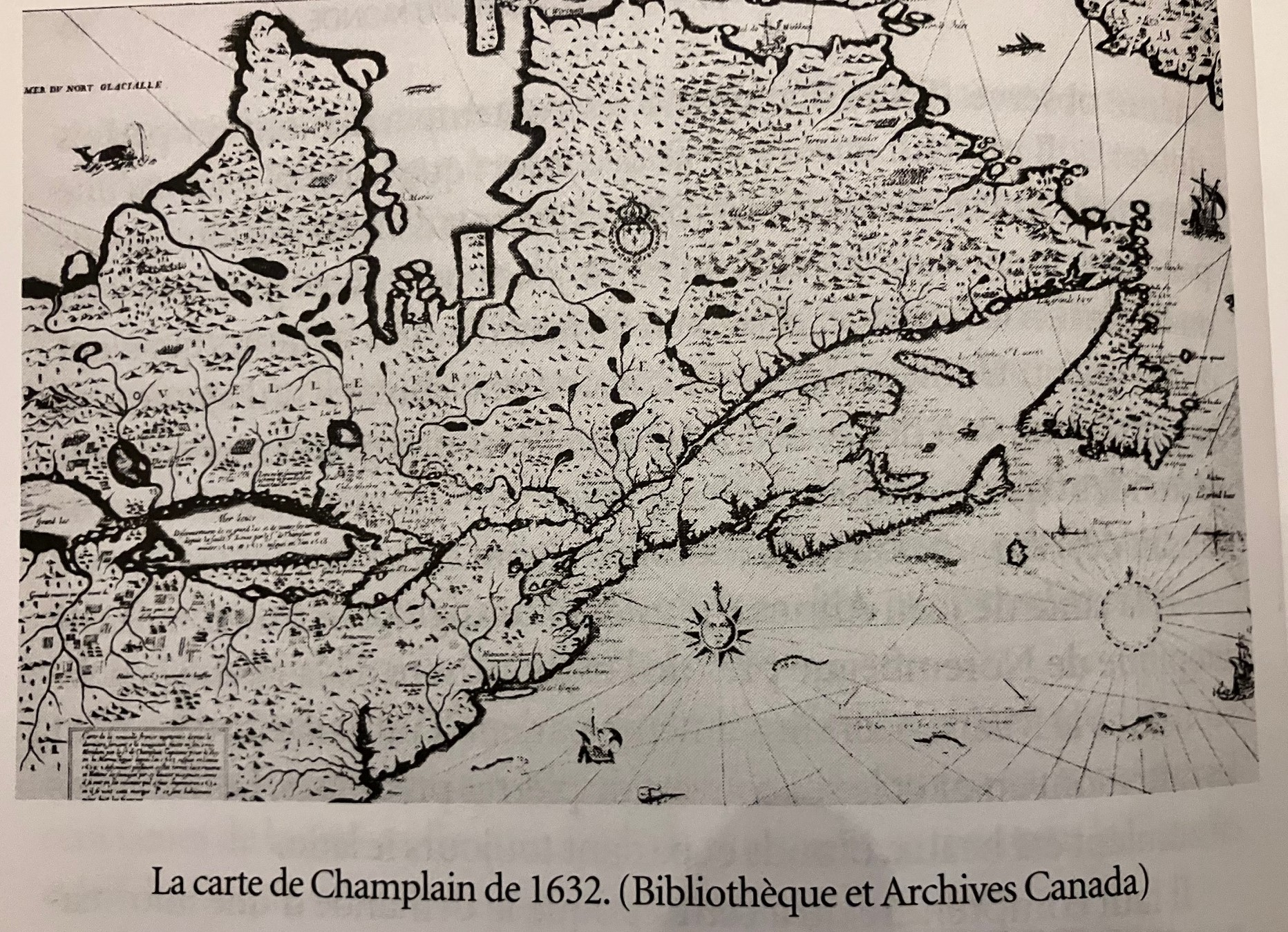
The map drawn by Champlain in 1632 provides a useful pictorial image of what was known of the geography of New France at this period. In many ways the placing, dimensions and spacing of landmarks such as Newfoundland and Nova Scotia in eastern Canada, the lower Great Lakes watershed andHudson Bay reveal the work of a skilled map maker.
Nothing in Champlain’s writings provides any evidence of a specific interest in the birds he saw. The words he used for the birds he saw were applied to species that he was familiar with in Europe. Like men of his day his interest was primarily in species hunted for food or in bird colonies where he could collect eggs. As a result his descriptions are limited to the generic naming of species with no details on size, plumage, behavior, nesting etc. His observations are historically important but add little to our knowledge of Canadian ornithology.
Champlain travelled widely in New France and Acadia providing important descriptions of each colony. In New France, perhaps his most important ornithological observation relates to a bird he describes from the lower Rideau Lakes in what is now the province of Ontario in late October, 1615 (Biggar 3: 86):
When we first went out hunting, I penetrated so far into the woods in pursuit of a certain bird which seemed to me peculiar, with a beak almost like that of a parrot (perroquet), as big as a hen (poule), yellow all over, except for its red-head and blue wings (ailes), which made short successive flights like a partridge (perdrix), that my desire to kill it made me chase it from tree to tree for a very long time, until it flew away in good earnest. After losing all hope of getting it, I wished to retrace my steps, but found none of our hunters, who had kept hurrying toward their enclosure... I found that I was lost in the woods.
The identity of this bird is a very difficult to resolve. For the most part Champlain’s writings provide plenty of evidence of a keen observer of his surroundings. His writings show a man of education with wide interests in the politics of New France, its native peoples, the landscape, and the wildlife, especially game species.
The only reason he discusses this bird is that he considered it unknown to him and highly unusual. If we take him at face value, but examine more the impression of the bird, we might infer that it was a bird of the woods and that it was the size of a chicken and that it had the following notable features: a large bill, general yellowish appearance from underneath, some red on the head and blue in the wing.
This description fits only one North American bird, the Carolina Parakeet. Mentioned by other observers in the 17th century this may be the only concrete evidence of the bird in Canada.
Today birders and ornithologists know that the Rideau Lakes region is a remnant Carolinian habitat as evidenced by the small population of Louisiana Waterthrushes as well as Yellow-throated Vireos, Golden-winged and Cerulean Warblers. It is certainly possible that Carolina Parakeets, a Carolinian species, visited this area in the 17th century.
Bibliography
- Biggar, H. P. ed. 1971. The Works of Samuel de Champlain, 6 Vols. Toronto: University of Toronto Press
- Escarole, Marc. 1914. History of New France. 3 Vols. Toronto: The Champlain Society
- Trudel, Marcel. 1966. “Samuel de Champlain” Dictionary of Canadian Biography 1. Toronto/Quebec: University of Toronto/Université Laval